Culinary Atlas · Texas · Neighborhoods, work, and restaurant tables
Houston
Follow a food route through the East End, family businesses, regional Mexican kitchens, and the restaurant tables that helped fajitas reach a wider public.
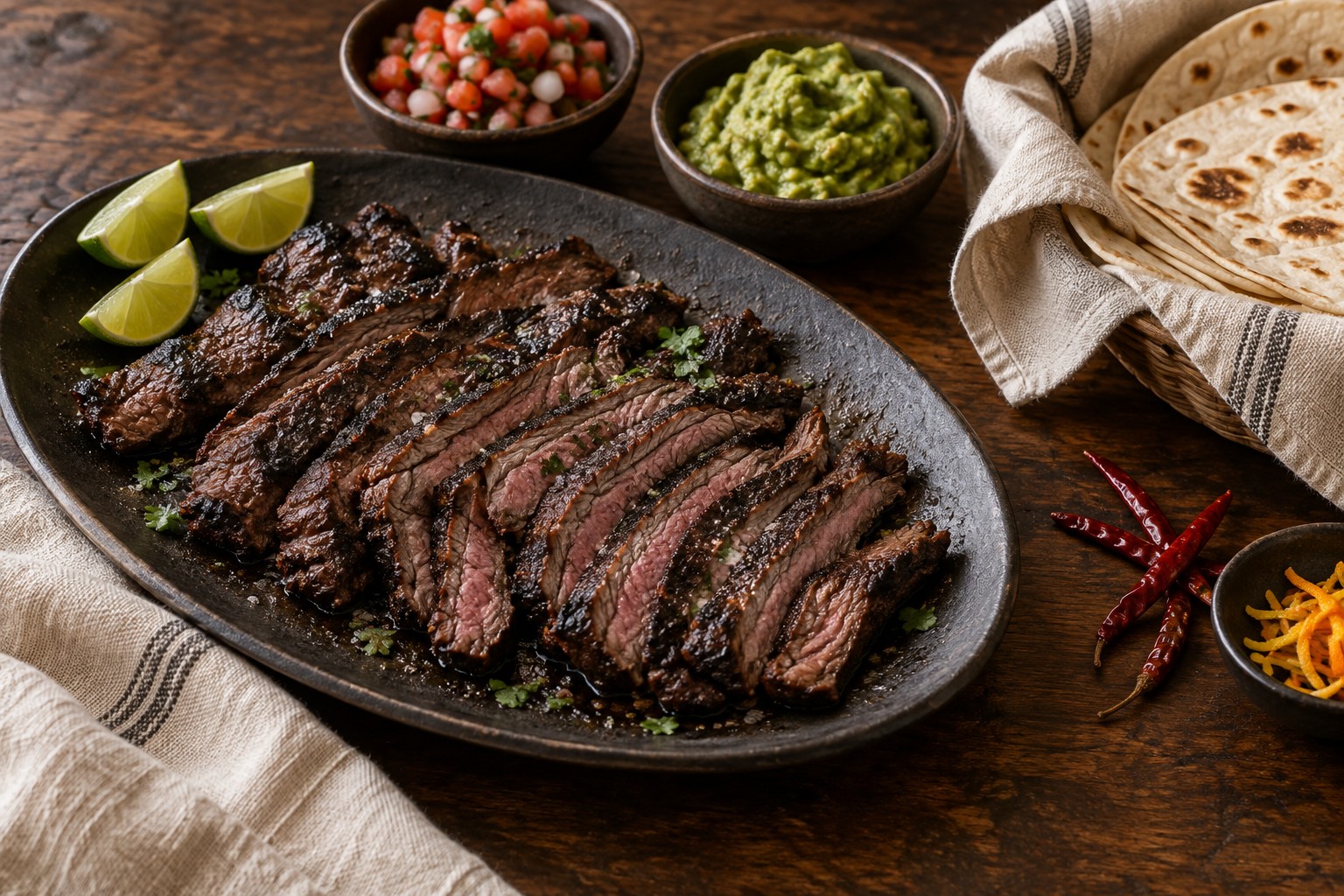
Houston is one chapter in the Fajita story. Begin there for the South Texas and fairground accounts, or stay with this city to explore the people and businesses behind the restaurant meal. The illustration below shows our Citrus-Sherry Skirt Steak Fajitas, a home-cooking recipe rather than an archival Houston restaurant plate.
A working city gives the table its setting
Houston's food history sits within a city shaped by transportation and labor. Port Houston's historical account dates the ceremonial opening of the widened ship channel to November 10, 1914. The waterway is part of the city's larger working landscape; that date alone does not explain an individual dish.
The city's Second Ward Action Plan describes a neighborhood east of downtown and south of Buffalo Bayou, with shipping, warehouses, and rail work in its history. Mexican settlement helped give it the name Segundo Barrio. The plan identifies Our Lady of Guadalupe Church, opened in 1912, and Navigation Boulevard's community institutions among its landmarks.
The 2018 plan also discusses preserving neighborhood identity while addressing development and displacement. A food atlas should keep those residents and institutions visible. A restaurant can draw visitors from across a city while still belonging to the everyday life of its neighborhood.
A tortilla business became a restaurant
Meredith May's Handbook of Texas biography identifies Ninfa Rodríguez Laurenzo's Harlingen upbringing and the family's move to Houston. In 1949, she and her husband opened Rio Grande Food Products Company, supplying tortillas and pizza dough. The biography follows the business through his death in 1969 and her effort to keep it operating.
The Handbook's restaurant entry places the ten-table Ninfa's in the front of the factory in 1973. It describes tacos al carbón, green sauce, and the restaurant's growing audience. Its 1976 Westheimer expansion gives the story a second setting beyond Navigation.
Leigh Cutler's 2005 profile brings family work into view, including the tortilla business and the involvement of Laurenzo's children. That background matters beside the famous menu item. Cooking, financing, serving, and sustaining a business are different kinds of work within a restaurant's history.
The Rio Grande Valley atlas provides a useful regional connection, while the Fajita story's Houston section separates popularization from an unsupported claim of sole invention. The home recipes linked here remain individual preparations with their own sources.
Navigation held more than one Mexican restaurant tradition
In her 2011 Houston History interviews, Mikaela Garza Selley records Rafael Acosta's account of Merida Mexican Café, opened by his parents Rafael and Olga in 1972. He describes introducing Yucatán dishes, including cochinita pibil and black beans, to the restaurant's customers.
Selley's article also follows Cesar Rodríguez's Doneraki and Velia Arcos Rodríguez Durán's Villa Arcos. Her interview accounts show different menus, working routines, and family circumstances within the same city. They are dated histories, rather than a current restaurant directory.
These family accounts show several regional traditions within one city. Each kitchen deserves its own history.
Restaurants also made room for public life
Selley's reporting describes Felix Tijerina's restaurant as a gathering place for Mexican American groups, and later restaurants as settings for community meetings and campaign events. Her interviews connect the dining room with civic participation as well as food.
Compare other urban tables in the Dallas atlas and the San Antonio atlas.
The side dish has a Houston source of its own
Los Tios's own history page dates its beginning under the Garbett family to 1970 and its purchase by the Adair family to 2000. That is the restaurant's account of its business history, giving a named setting to one of the side dishes in this collection.
Our Mexican Rice comes from the owner-supplied “Los Tios Mexican Rice” recipe in Robb Walsh's The Tex-Mex Cookbook, page 163. The recipe page preserves that source's quantities and cooking sequence. This published cookbook connection does not establish what every present-day Los Tios kitchen puts in its rice.
Rice and beans remain complete preparations even when they arrive beside the main dish. Use the Combination Plate story to follow that meal format, then make the rice, Refried Beans, and main dish from their respective instructions.
Bring the reading back to a complete meal
For the founder's own remembered method, choose Classic Beef Fajitas. Compare Citrus-Sherry Skirt Steak Fajitas or the archived Ninfa-Style Citrus Fajitas for distinct preparations. Their recipes are not presented as a reconstruction of every restaurant dish described in this article.
The full fajita collection connects the remaining no-marinade, arrachera, lime, and other archived versions. Keep the chosen recipe's cut and seasoning together. For the table, choose Homemade Flour Tortillas, Pico de Gallo, Guacamole, and salsas according to the meal you are making.
Explore Houston's people, places, and food record
- Port Houston, Background and History — the ship channel chronology.
- City of Houston, Second Ward Action Plan, 2018 — printed pp. 9 and 38 for geography, landmarks, and neighborhood concerns.
- Meredith May, Handbook of Texas: Ninfa Laurenzo and Ninfa's Mexican Restaurants — biographical and business accounts.
- Leigh Cutler, “Mama” Ninfa Rodriguez Laurenzo, The Houston Review, 2005, p. 11 — family work and restaurant history; endnotes p. 77.
- Mikaela Garza Selley, House Special: Mexican Food & Houston Politics, Houston History, Fall 2011, pp. 30–32 — interviews with restaurant families and civic context.
- Los Tios, About — the restaurant's own business chronology. The rice recipe's cookbook source is documented on the recipe page.
Read the Fajita story · Cook Mexican Rice · Browse the Culinary Atlas · Suggest a correction