Food Stories · Restaurant tables
The Texas Combination Plate
One order, several preparations. Follow the documented restaurant account without giving the whole plate a mythical inventor.
What is on the table
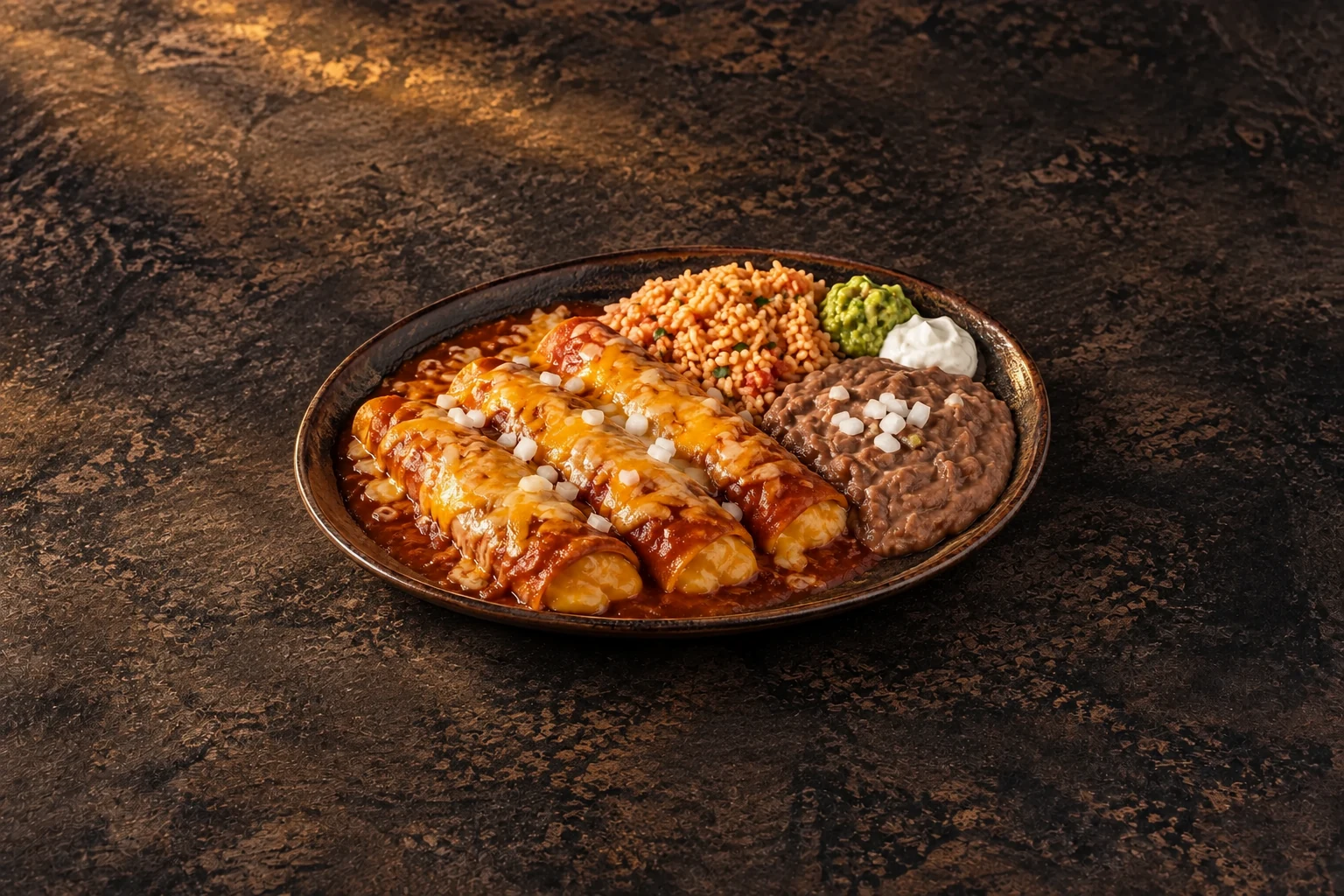
A combination plate lets an enchilada, rice, beans, and sometimes another item share one restaurant order. The familiar arrangement is useful precisely because the components are different: sauce and cheese belong to the enchilada; the rice has its own tomato-and-broth method; the beans are cooked and mashed separately. Serving them together does not make them one recipe or give them one origin.
What the Dallas record says
The Handbook of Texas account of Miguel Martinez records that he and Faustina Porras opened Martinez Cafe in Dallas in 1918 and renamed it El Fenix in 1922. It says some sources assert that Martinez pioneered a “Mexican combination plate” of beans, a tamale, an enchilada, and rice. His daughter Irene suggested that combining the food on one plate saved dishwashing.
That language matters. It documents an attribution to a particular restaurateur and a family explanation for the format. It does not establish the first time anyone served several foods together, nor does it prove that every Texas combination plate descended from one menu.
Why the label became contentious
UTSA Special Collections notes that “the combination plate” was used in a dismissive comparison of Tex-Mex and Mexican cooking in 1972. The label can still carry that argument, but it need not dictate how we judge the food. A plate can be straightforward and carefully cooked at the same time. The useful questions are more exact: What is the enchilada sauce? How was the rice made? Are the beans smooth or whole? Which parts are served fresh?
Cook your own combination
Begin with the complete Texas Cheese Enchiladas recipe, then add Mexican Rice and Refried Beans. Each page gives its own amounts and method. Cook the components as written, then arrange generous but distinct portions on an ordinary plate. This is a serving path, not a new composite recipe with invented quantities.
What is documented—and what is not
The Martinez dates and qualified plate attribution come from the Handbook of Texas; the changing use of the Tex-Mex label comes from UTSA Special Collections. The Border Table does not claim a sole inventor, an exact date for the first plate, or that one plate speaks for every Texas Mexican restaurant.
Browse more Food Stories · See Dallas in the Culinary Atlas · Send a correction