Culinary Atlas · North Texas
Dallas
One restaurant’s documented plate belongs within a larger neighborhood history of migration, work, and Mexican-owned businesses.
The combination plate is familiar enough to seem timeless. Dallas records offer a more precise way to talk about it: one family business, an attributed serving format, and a neighborhood that made such businesses possible.
Little Mexico was a neighborhood, not a menu
The Handbook of Texas describes Dallas’s Little Mexico as a community north of downtown that became predominantly Mexican after migration associated with the Mexican Revolution. It records schools, churches, stores, restaurants, housing, and other parts of neighborhood life. Exclusion under Jim Crow was part of why residents built institutions there. Food businesses belong to that social history; they were not merely picturesque stops on a restaurant trail.
The Martinez family and a qualified claim
The Handbook’s biography of Faustina Porras Martinez says she and Miguel Martinez opened Martinez Restaurant on McKinney Street in 1918. Miguel’s biography records a 1922 expansion and the name El Fenix. Both people and the family business belong in the story, not only the brand that survived.
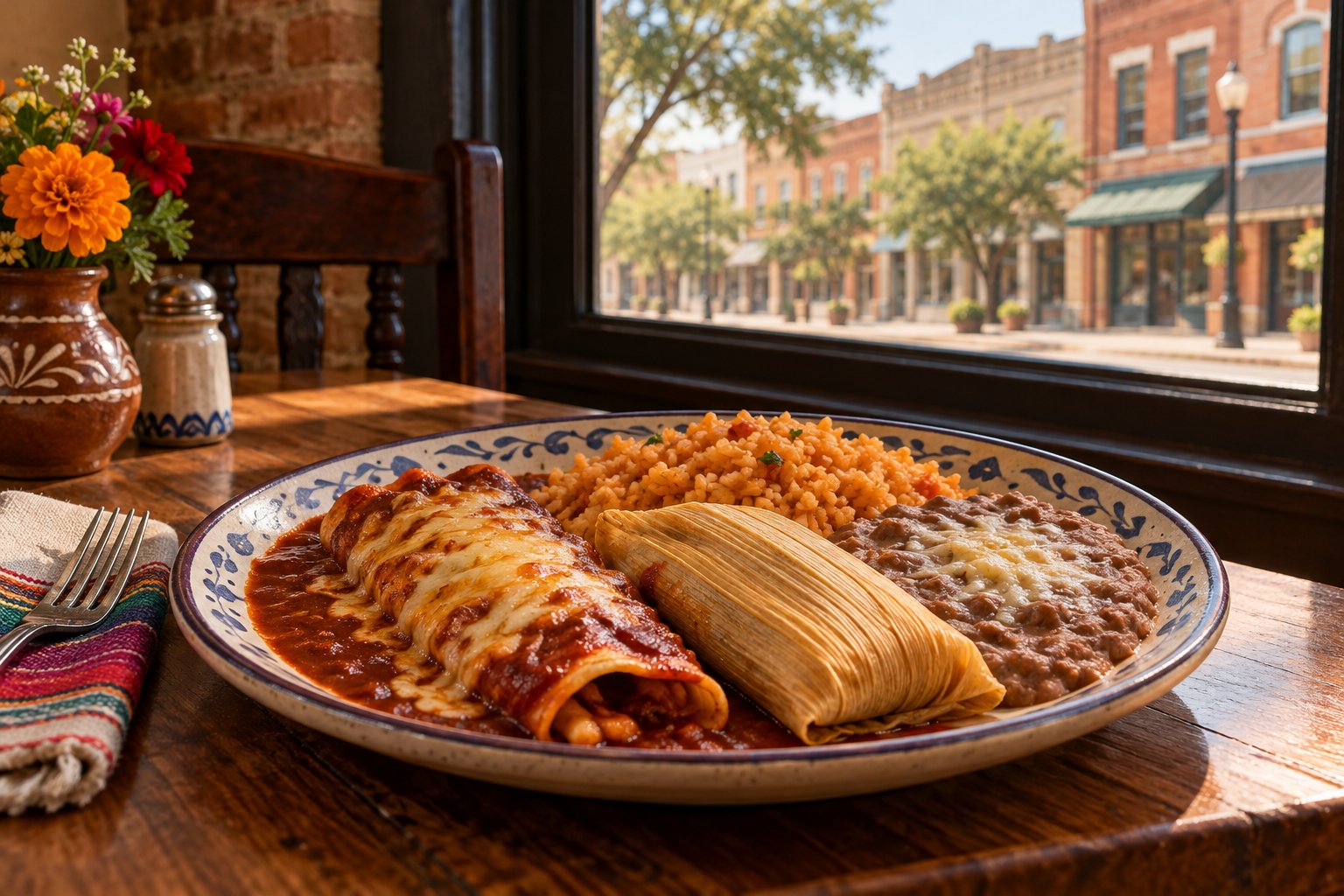
The same Miguel Martinez entry says some sources assert that he pioneered a Mexican combination plate of beans, a tamale, an enchilada, and rice. His daughter Irene suggested the arrangement saved dishwashing. Those are reported attributions. They do not prove that no one elsewhere had served several foods together before, or that every later restaurant used the same components.
What to notice on the plate
A combination plate can hold distinct preparations without erasing them. Enchilada sauce and cheese, seasoned rice, mashed beans, and a tamale each call for their own method. Our combination-plate food story goes deeper on the attribution and the changing reputation of the Tex-Mex label. To make a related plate, cook Texas Cheese Enchiladas, Mexican Rice, and Refried Beans from their complete pages. Their recipes are not presented as the Martinez family’s original formulas.
Move south to San Antonio for a different Texas Mexican public-food history. The Dallas restaurant account should not be transferred to the city’s earlier plaza sellers.
Sources and limits
The Handbook’s Little Mexico entry supplies neighborhood context; the Faustina Porras Martinez and Miguel Martinez entries supply the business dates and explicitly qualified plate attribution. We do not claim a sole inventor or an exact original combination-plate recipe.