The Border Table
Tamales Rojos
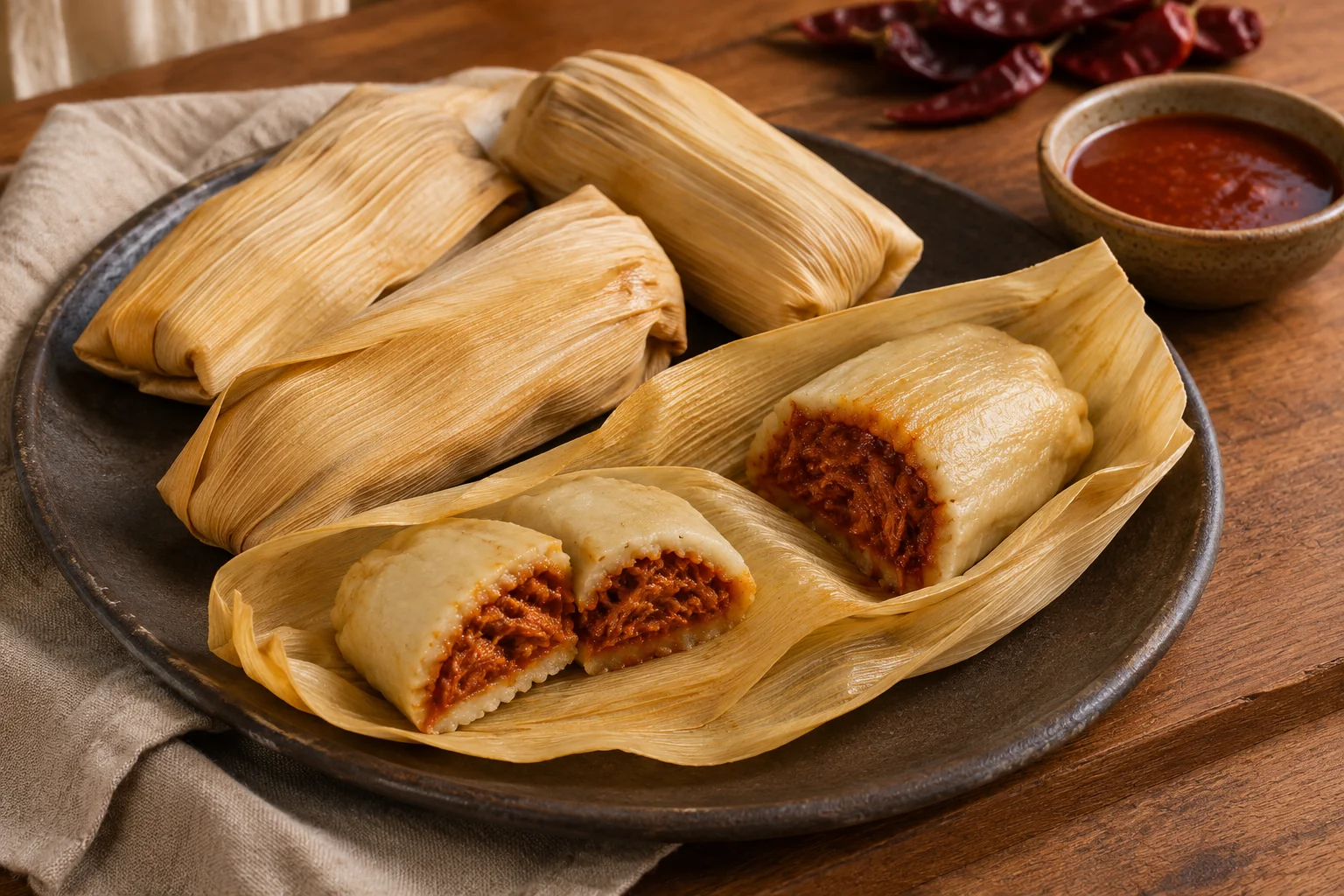
Make a tender pork-and-red-chile filling, spread a light masa into corn husks and steam the tamales until the dough sets cleanly away from the wrapper.
Corn-husk tamales with pork in guajillo-ancho sauce
Cook it
Make Tamales Rojos
Plan your time: Prep 1 hr 15 min · Cook 3 hr 30 min · Rest/soak 15 min. Times are estimates; follow the cooking cues in the steps.
Before you start: Choose masa harina for tamales; the grind and water absorption differ between products. Start the pork first and soak the husks while it cooks. Let broth cool before beating it into lard. Do not use a dough-floating test as a substitute for cooking and opening a sample tamal.
- Cook the pork. Cover the pork with water in a large pot. Add half the onion, 2 garlic cloves, bay leaf and 1 teaspoon salt. Bring to a simmer, skim and cook partly covered for about 1½–2 hours, until the meat pulls apart readily. Strain and reserve at least 3 cups broth, adding water if needed. Shred the pork and discard the bay leaf and spent aromatics.
- Prepare the husks and chiles. Soak the husks in hot water for at least 30 minutes, using a plate to hold them under. Briefly warm the guajillos and anchos on a dry medium-hot skillet, turning before they scorch. Cover the chiles with hot water for 20 minutes, then drain.
- Make the filling. Blend the softened chiles with the remaining onion and 2 garlic cloves, cumin, oregano and 1 cup reserved broth. Heat the tablespoon oil in a saucepan. Carefully add the sauce and simmer for 10 minutes, stirring. Fold in the shredded pork and simmer 5 minutes more. The filling should be moist, without free-flowing sauce. Taste and adjust salt, then let cool enough to handle.
- Mix the masa. Mix the masa harina with 2 cups cooled broth; rest 10 minutes. Beat the lard for 3–4 minutes until lighter. Beat in the baking powder and remaining 1 teaspoon salt. Add the hydrated masa in several portions and beat for about 5 minutes. Add plain water a tablespoon at a time, up to ½ cup, only if needed for a soft, thick spreadable dough; it must hold on a husk without running.
- Fill and fold. Drain and pat the husks dry. With the broad end facing you, spread about 45–50 g dough into a roughly 4-inch square, leaving a margin at the sides and the narrow tip bare. Put about 30–35 g filling down the center. Fold the sides inward so masa surrounds the filling, then fold up the narrow end. Keep the upper end open. Divide the dough and filling evenly among 24 tamales; use any small extra filling as a separate accompaniment.
- Steam. Add water below the steamer rack; the tamales must not sit in water. Line with spare husks and arrange tamales upright, open ends up, with a little room for steam. Cover with spare husks and the lid. Bring to steady steam, then maintain it for about 75 minutes. Check the water every 25–30 minutes and add boiling water carefully at the side when needed.
- Check the dough. Remove one tamal with tongs, rest it for 5 minutes and open it. The masa should be set and release cleanly from the husk, with no raw paste at the center. If still tacky, steam 15 minutes longer and check again. Rest the finished covered batch off the heat for 15 minutes. Remove and discard the husks before eating.
Adjust the texture
Dry, stiff dough needs a little more liquid before spreading. A leaking filling needs reducing before assembly. Masa that sticks as raw paste after a short rest needs more steaming, provided water remains below the rack. Do not pack the steamer so tightly that steam cannot circulate.
Serve and keep
Cool in shallow containers and refrigerate within 2 hours. Store at 40°F (4°C) or colder for 3–4 days, or freeze individually wrapped. Steam refrigerated or thawed tamales until the filling reaches 165°F (74°C); unwrap only after heating.
Understand it
What the method is doing
The wrapper holds the dough together while steam cooks it. A cooked, reduced filling limits excess water at the center. Beating fat into hydrated masa changes its structure, and the final rest lets the hot dough become firmer before you pull away the husk.
Know it
Follow the food
UNAM’s historical account places tamales within Mesoamerican maize cooking with many fillings. Modern pork-and-lard preparations are one branch of that wider family. This recipe uses red chiles and corn husks; it does not stand for every region’s tamales.
Sources and further reading
- UNAM Noticonquista: Pan de Indias, tamales y tortillas — Historical maize processing and varied tamal fillings.
- Jauja Cocina Mexicana: Tamales Rojos Bien Esponjados — Mexican practitioner comparison for masa and red pork filling; proportions and instructions here are developed separately.
- Larousse Cocina: Tamales de rajas y verdes — Corn-husk masa assembly and a different pork-salsa preparation.
- FoodSafety.gov: Safe Minimum Internal Temperatures — Reheating endpoint.
Have a source or cooking detail to add? Send a correction.