San Francisco · Research Edition
Mission-Style Burrito
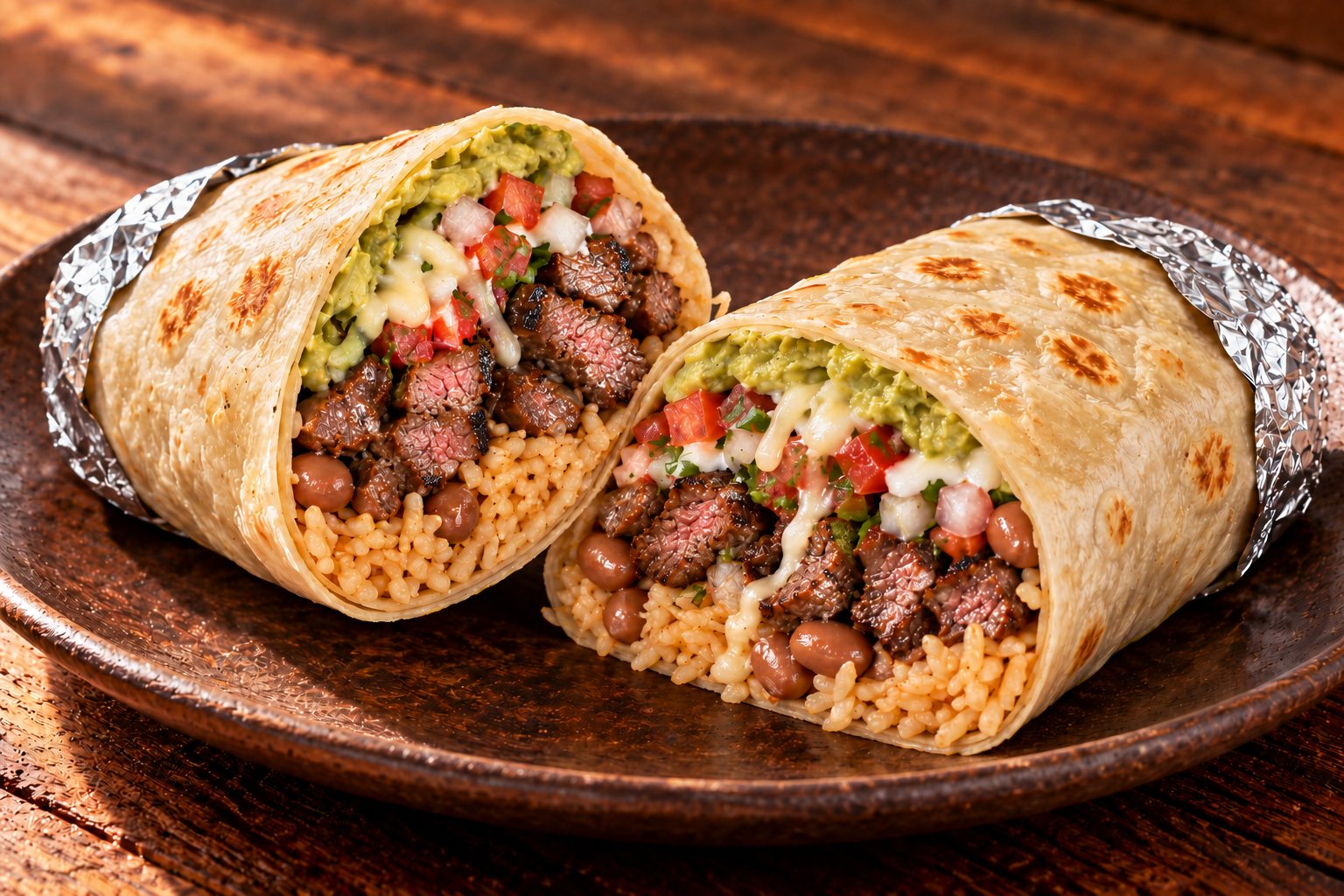
A generous carne asada burrito with rice, whole pinto beans, pico de gallo, avocado, cheese, and crema, wrapped snugly in a warm flour tortilla and foil.
Before you start
Have the rice cooked before heating the steak. A 12- to 13-inch tortilla is useful here: the filling needs room to be tucked in, not simply piled high. This is a newly developed, untested Border Table version, not a claim to reproduce a particular Mission District taqueria.
Cook it
- Make the pico. Mix the tomato, onion, cilantro, lime juice, and ¼ teaspoon salt. Drain away excess liquid before assembly so the tortilla does not become wet.
- Season the steak. Pat the steak dry. Rub it with the oil, 1 teaspoon salt, pepper, and garlic. Heat a heavy skillet or grill pan over medium-high heat until a drop of water sizzles and evaporates promptly.
- Cook and rest. Cook the steak in a single layer, in batches if the pan is crowded, until well browned and a thermometer inserted into the thickest part reads 145°F (63°C). Thickness changes the time; begin checking after about 3 minutes per side. Rest at least 3 minutes, then slice thinly across the grain and chop into bite-size pieces. Toss the pieces with any juices collected on the resting plate.
- Warm the filling. Heat the cooked rice and drained beans separately until hot; if using refrigerated leftovers, reheat them to 165°F (74°C). Keep the beans moist but not soupy. Warm each flour tortilla briefly in a dry skillet or covered pan until it folds without cracking; do not toast it stiff.
- Fill four burritos. Working with one tortilla at a time, place one-quarter of the rice, beans, steak, cheese, drained pico, mashed avocado, and crema in a compact strip just below its center. Leave at least 2 inches clear at both ends. Keep the wet toppings modest; do not pack the tortilla to its edge.
- Roll and serve. Fold the short sides inward, lift the near edge over the filling, tuck it beneath the filling, and roll firmly into a cylinder. Wrap tightly in foil and rest seam-side down for 2 minutes. Serve whole, or cut through the foil and tortilla just before eating.
Keep the burrito together
If the tortilla splits, warm it longer under a cover and use less filling in the next one. Keep the steak’s resting juices with the meat, but drain excess liquid from the pico and beans. A firm foil wrap helps the burrito hold its shape; it is not a substitute for leaving space at the edges.
Make ahead and store safely
Cook the rice and beans ahead if you like, then refrigerate them promptly and reheat to 165°F (74°C) for assembly. For leftovers, keep the steak, rice, beans, and cold toppings in separate shallow, covered containers; refrigerate perishables within 2 hours, or within 1 hour above 90°F (32°C), and use within 3 to 4 days. Reheat cooked leftovers to 165°F (74°C), then add fresh pico, avocado, and crema. A fully assembled burrito will soften as it sits.
Untested variations: You can leave out the crema or cheese, but the burrito will be less rich. Some Mission District burritos omit rice; that is a different version, not the measured filling above.
Understand it
Why the warm tortilla matters
A warm, supple flour tortilla can stretch around the filling and tuck at the ends. Dry rice and drained whole beans give the interior structure; extra liquid from salsa or beans makes a large burrito harder to roll and quicker to tear. Foil holds the finished cylinder together as you eat.
Know it
A neighborhood style, not one fixed formula
The large, foil-wrapped burrito is associated with San Francisco’s Mission District, but a single inventor is not established. KQED’s interviews with Mission taqueria owners also show that the label “Mission-style” is not universal among the people making these burritos. Rice is common in many versions, yet La Taqueria’s well-known burrito omits it. This recipe is one explicit, cookable interpretation—not a rule for every Mission table.
Sources and edition
About this version
We developed this Research Edition from documented descriptions of large, foil-wrapped Mission District burritos and practical home-kitchen methods. It is not a named taqueria’s formula, and we have not kitchen-tested it. The time and yield are estimates.
- KQED Bay Curious: “What Is a Mission-Style Burrito? Maybe … a Myth” — interviews on the style’s varied forms and disputed name and origin.
- FoodSafety.gov safe minimum temperatures — 145°F and a three-minute rest for whole beef cuts; 165°F for leftovers.
- USDA FSIS food-safety basics — prompt refrigeration and 3-to-4-day storage for most cooked leftovers.
Revised 6 October 2026. For corrections, see our corrections policy.