Food Stories · Corn tortillas, chile, and the Texas table
Cheese Enchiladas: Red Chile and the Texas Table
A soft corn tortilla, cheese, onion, and sauce can become a rolled dinner or a layered stack. Cookbooks, a family restaurant account, and a surviving menu show how much history that familiar plate can hold.
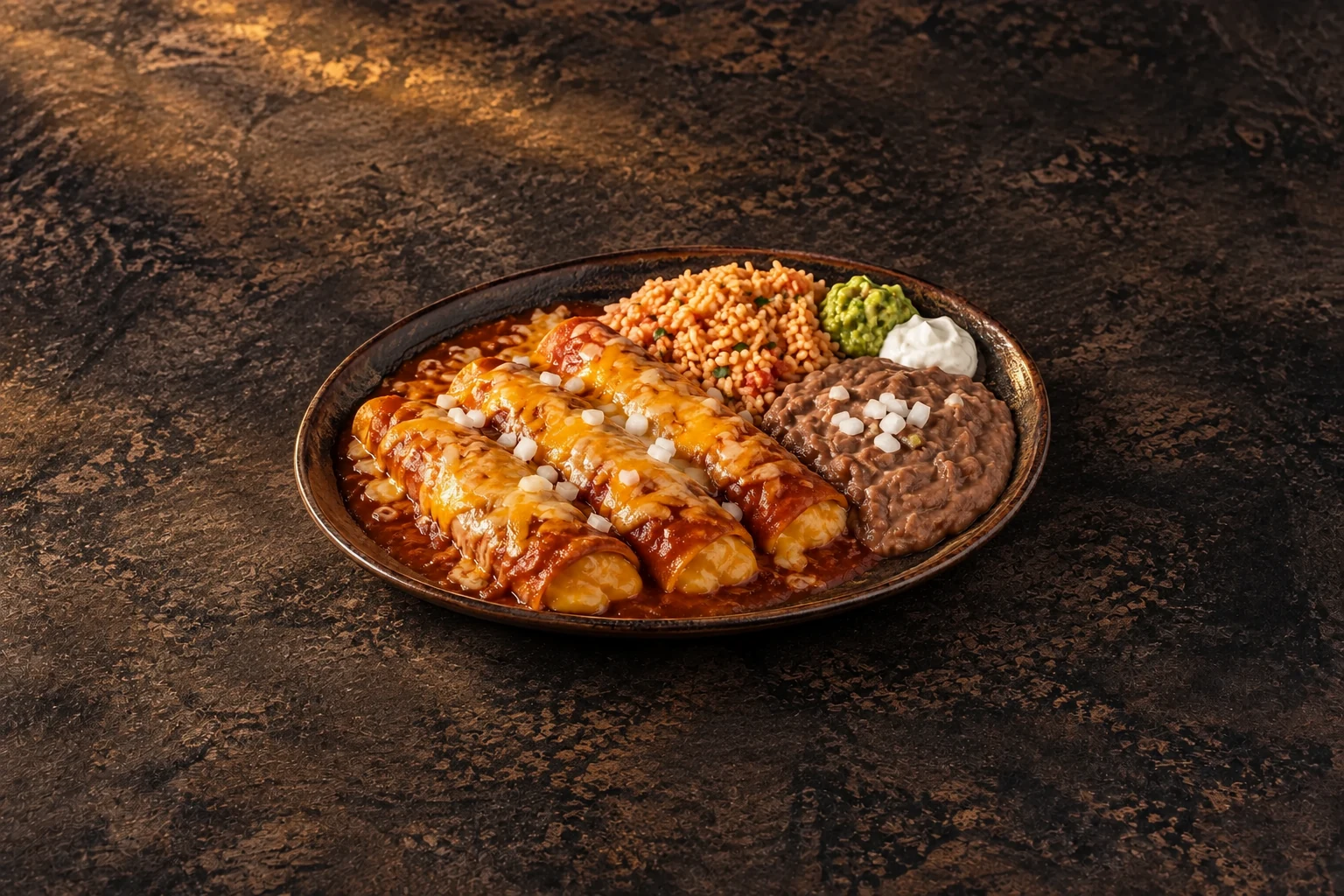
Our Texas Cheese Enchiladas with Red Chile Sauce lead with rolled tortillas, with a stack offered as an assembly of the same recipe. The ingredients and sauce belong to that particular page. Its wider story brings together Mexican cheese-filled enchiladas, West Texas flat preparations, and the restaurant combination plate.
A cheese filling appears in more than one cookbook tradition
UTSA Special Collections' transcription of Enchiladas Guadalajara preserves a recipe from Ruth Watt Mulvey and Luisa Maria Alvarez's Good Food from Mexico, published in 1950. It rolls tortillas around fresh cheese, avocado, peppers, and radishes, with a sauce that includes cream. That is a specific published preparation, quite different from the melted cheese and dried-red-chile sauce on our page.
The example is valuable because it gives the comparison an actual recipe. A cheese-filled enchilada does not have to mean one cheese, one sauce, or one restaurant style. The book title and recipe name also do not turn a single written formula into a rule for every kitchen in Guadalajara.
A useful starting point is to ask what the tortilla carries, how the sauce is made, and how the dish is assembled. Those questions keep distinct preparations visible without requiring a single inventor to explain them all.
Texas has regional differences within the familiar dish
Joe S. Graham's Handbook of Texas account of Tex-Mex food describes flat enchiladas in West Texas and New Mexico: tortillas layered with chile, cheese, and onion, sometimes finished with a fried egg. He places them within a discussion of differences between West and South Texas foodways.
Read that as a regional description, with room for individual cooks. It helps explain why a stack belongs in a West Texas conversation, while a rolled cheese enchilada remains familiar on restaurant plates elsewhere. It is not a reason to insist that every cook on one side of the state must assemble the dish the same way.
UTSA's Tex-Mex overview identifies cheddar and gravy-style enchilada sauces among recognizable features of the cuisine, while describing continuing ties with northern Mexico. That broad account provides context for a restaurant tradition. A particular plate still needs its own sauce and ingredient list.
An Old Borunda account connects the stack with named people
The Marfa Public Library's digitized record of Lupe J. Lujan's 1965 history preserves a school research paper about the Old Borunda Café and the women behind it. It is a local-history source to explore alongside the later food writing, rather than a surviving measured recipe.
In his October 2012 account of meals and conversations in Marfa and Houston, writer J. C. Reid spoke with Pancho Borunda and Robb Walsh. Reid reports that Walsh obtained an oral description of Carolina Borunda Humphries's enchiladas from Pancho for The Tex-Mex Cookbook. He also records disagreement about a later restaurant version that added pork.
That disagreement makes the story more specific. A restaurant can draw on a remembered preparation and still change its filling or sauce. A published adaptation and a relative's account need to be read with their differences intact.
Our recipe page identifies Walsh's published sauce-and-stack account as its source and explains that the rolled assembly is The Border Table's adaptation. The optional stack uses the same batch of sauce, tortillas, cheese, and onion. It offers a second way to assemble the recipe, without presenting the rolled photograph as an archival Old Borunda plate.
A surviving Dallas menu places enchiladas within a larger dinner
The Portal to Texas History preserves an El Fenix menu cataloged to about 1951. Its dinners combine enchiladas with other preparations, including tamales, beans, and rice. It also lists combination plates and enchiladas served with eggs. The approximate date comes from the catalogue.
The menu shows what one restaurant offered. It does not provide an enchilada sauce formula or identify every filling, so it cannot authenticate this site's cheese recipe. What it does make visible is a way of arranging a meal: an enchilada can be one part of a substantial restaurant dinner.
The Combination Plate story follows that format in detail. The Dallas atlas places the restaurant beside neighborhood and family-business history; the San Antonio atlas opens another city's public and restaurant tables.
The sauce tells you which recipe you are cooking
Our cheese-enchilada recipe begins with softened dried red chiles blended with onion and garlic. A blond flour-and-oil base thickens that puree. Its red-chile character matters: the phrase cheese enchiladas alone does not tell a cook whether the sauce begins with whole pods, a spice mixture, tomatoes, or meat.
For a separate preparation, the owner's archived Red Chile Enchilada Sauce has its own recorded ingredients and method. The How to Roll Mexican Enchiladas card likewise preserves a different assembly guide. Use each complete page as written, rather than taking a quantity from one and a cooking step from another.
The tortilla is just as important. In the main recipe, a brief oil-softening stage lets a corn tortilla bend around cheese and onion; the sauce and oven finish bring the plate together. The optional stack keeps the tortillas flat and places sauce and filling between them. The shape changes where the layers meet, while the measured recipe stays the same.
For the chile setting, follow El Paso & Paso del Norte and the Santa Fe & New Mexico atlas. Those places offer related regional reading without making Marfa, El Paso, and Santa Fe interchangeable.
Bring the story back to a complete meal
Cook the rolled cheese enchiladas as the main presentation, or follow that page's optional stack. Prepare Mexican Rice and Refried Beans separately if you want a combination plate. The Rio Grande Valley atlas provides another path through the site's home and restaurant tables.
A corn tortilla guide helps with the wrapper used here. To explore the different dough behind burritos, fajitas, and many border tacos, continue to the Flour Tortilla story. Both staples deserve their own methods and histories.
Read the cooks and the records
- UTSA Special Collections, Enchiladas Guadalajara, 1950 — its transcription of Mulvey and Alvarez's published recipe.
- Joe S. Graham, Handbook of Texas: Tex-Mex Foods — regional preparations.
- UTSA Special Collections, Tex-Mex: A Regional Cuisine — broader restaurant and culinary context.
- Lupe J. Lujan's 1965 Old Borunda history, Marfa Public Library — the catalogue and digitized local-history record.
- J. C. Reid, A Tale of Two Enchiladas, October 25, 2012 — firsthand reporting and attributed conversations.
- El Fenix menu, about 1951, Denton Public Library — preserved by the Portal to Texas History.
- Robb Walsh, The Tex-Mex Cookbook (2004), p. 106 — the source identified on our existing enchilada recipe; publisher's book record.
Cook the cheese enchiladas · Follow the combination plate · More Food Stories · Suggest a correction