Culinary Atlas · Northern Coahuila & the Texas border
Piedras Negras–Eagle Pass
Two cities on one river connect a Mexican nacho story with northern Coahuila’s wider table, trade routes, and living cross-border communities.
Begin with the nacho story, then look beyond the platter. Piedras Negras is in Coahuila, Mexico; Eagle Pass is in Maverick County, Texas. They face each other across the river called the Río Bravo in Mexico and the Rio Grande in the United States. They belong to the same crossing, while keeping distinct local histories.
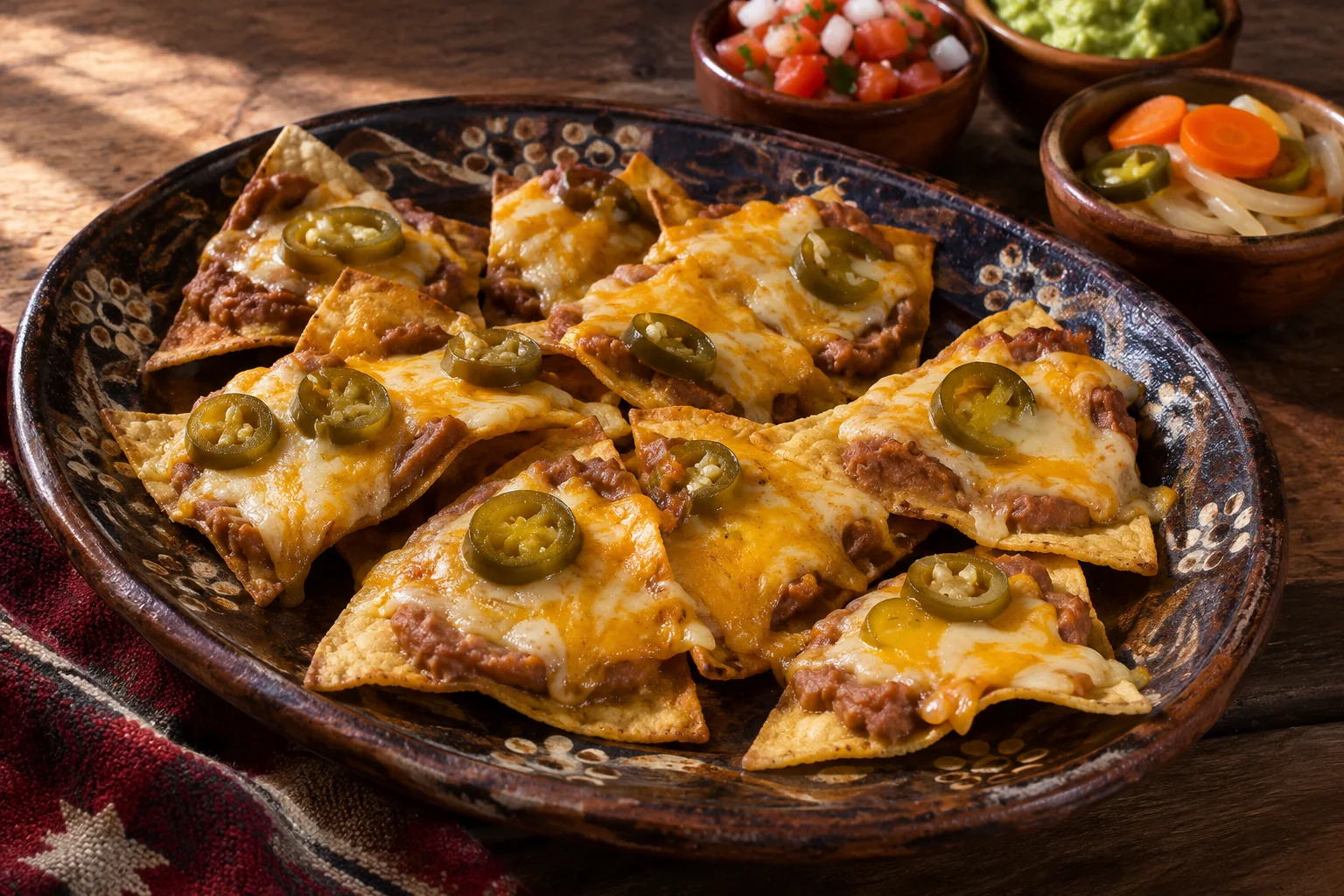
This image shows the associated recipe on The Border Table. It is a food illustration, not an archival view of either city or the first nachos.
A crossing before a famous dish
The City of Eagle Pass history traces the settlement to a river crossing and Fort Duncan, established in 1849. A stage line connected Eagle Pass with San Antonio in 1851. The railroad arrived in 1882, and rail construction continued across the river into Mexico. These links made the crossing part of a wider network of journeys and trade.
Coahuila’s municipal profile of Piedras Negras records a settlement opposite Fort Duncan in 1850. It names the early settlement Nueva Villa de Herrera and then Villa de Piedras Negras. The profile relates the name Piedras Negras to local coal-bearing deposits. These are accounts of the towns’ formation, rather than the beginning of human life along the river.
The Handbook of Texas describes a surrounding economy of ranches, coal mines, and farms, with irrigation strengthening agriculture in the 1930s and 1940s. It also records shopping and trade on both banks. That history gives the food story a setting: a border town is a place where people live, work, and return, as well as somewhere visitors pass through.
A living border includes more than two national stories
The Kickapoo Traditional Tribe of Texas locates its reservation beside the Rio Grande, south of Eagle Pass in the Rosita Valley community. Its own website is a starting point for understanding the community and its government.
A 2023 Texas House resolution describes the tribe’s history in Texas and northern Mexico, including ties to El Nacimiento, Coahuila, and movement across the border for seasonal agricultural work. This is part of the region’s living history. It should be recognized in its own right; the sources here do not attribute the invention of nachos to the Kickapoo community.
Northern Coahuila’s table is larger than nachos
Mexico’s Secretaría de Turismo survey of Coahuila cooking describes beef, cabrito, and pork alongside flour tortillas, tamales, red enchiladas with potatoes, machaca, and chile-seasoned stews. It also names regional cheeses and chorizo from Múzquiz. The survey covers a whole state, so its list should not be mistaken for a fixed menu in every Piedras Negras household.
The same survey includes milk-and-nut sweets, fruit preserves, and distinct breads associated with other parts of Coahuila. Those differences matter. A state’s best-known restaurant snack can be an inviting entry into its food without representing the whole of its home cooking or collapsing its different regions into one flavor.
UTSA Special Collections places ongoing culinary ties with Coahuila, Nuevo León, and Tamaulipas within the history of Tex-Mex. It describes northern Mexican cooking interacting with other Texas influences and available ingredients. That is a useful framework for this crossing: recipes can be shared and adapted without their Mexican setting disappearing from the account.
Nachos as a city’s food memory
The Piedras Negras visitors bureau credits Ignacio “Nacho” Anaya with the dish in 1943. Its description of Nacho Fest includes both traditional and inventive nacho categories, as well as jalapeños. The celebration gives the city a way to remember the dish while also making room for new versions.
That public memory has a visible setting. The bureau’s guide to local places describes the Paseo del Río corridor between the international bridges as a location for cultural and recreational events, including Nachos Fest. It also describes a historic center and public plazas. The dish belongs to a city with streets, gathering places, and a life beyond its most famous food.
For the restaurant account, the Eagle Pass church-cookbook paper trail, and the later stadium chapter, read Nachos: From the Original Bite to the Loaded Plate. The story keeps the evidence and the recipe choices together without treating our bean-topped versions as a reproduction of the first serving.
Cook the connection, then follow another place
Our Original Individually Topped Nachos is the owner’s archived recipe: beans, melted cheese, and jalapeño assembled on individual chips. Loaded Nachos (Nachos El Norte) offers a related bean-and-cheese preparation with heat at the side and an optional cooked-fajita finish. Both pages explain their own sources and methods.
Keep exploring the ingredients through Refried Beans, Classic Guacamole, and the jalapeño guide. These links help you make the table; they do not claim that every linked formula originated in Piedras Negras.
Continue to the San Antonio atlas for another Texas food landscape, or to Reynosa and Tamaulipas for a different paired border setting. The Rio Grande Valley follows the lower river farther downstream. Piedras Negras and Eagle Pass are a separate crossing, not part of that Valley region.
Sources and further reading
- City of Eagle Pass, “History of Eagle Pass” — the crossing, Fort Duncan, stage line, and railroad.
- Government of Coahuila, Piedras Negras municipal profile (PDF, p. 1) — the town’s name and nineteenth-century settlement account. Its older statistics are not used as present-day figures.
- Ben E. Pingenot, “Eagle Pass, TX,” Handbook of Texas — ranches, farms, irrigation, and cross-border trade.
- Kickapoo Traditional Tribe of Texas and Texas House Resolution 2499, adopted May 29, 2023 — community location and cross-border history.
- Secretaría de Turismo, “Gastronomía Mexicana: Coahuila,” September 4, 2015 — the wider state’s regional foods.
- UTSA Special Collections, “Tex-Mex: A Regional Cuisine” — northern Mexican and Texas culinary connections.
- Piedras Negras visitors bureau, Nacho Fest and local origin account, and “Puntos turísticos” — food commemoration and its public setting.
Follow the nacho story, choose the archived nachos or Loaded Nachos, or return to the Culinary Atlas. Have a source that adds to the picture? Send a correction.