The Border Table · Research Edition · Mexican American
Chimichangas
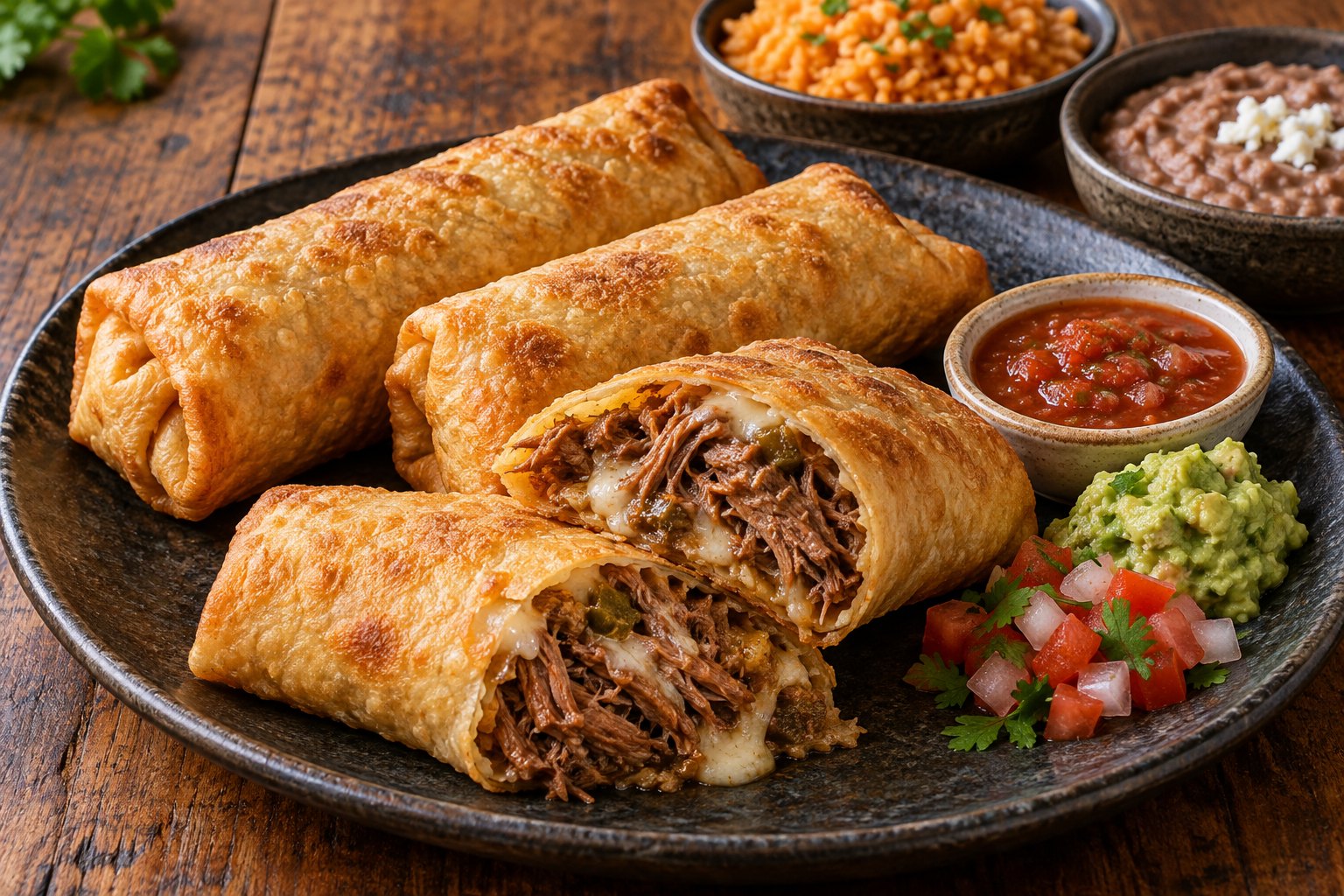
A thin flour tortilla fries to a crisp shell around tender green-chile beef and a little melted Jack.
The beef stays moist inside; salsa and cool accompaniments wait at the side so the first bite still crackles.
Cook the chimichangas
Before you start: Use a heavy, deep pan, a clip-on oil thermometer, tongs, and a rack over a tray. The beef must be fully cooked before folding; the short fry is for the tortilla, not for cooking raw meat.
- Brown the beef. Pat the chuck dry and season with the measured salt. Heat 1 tablespoon oil in a heavy Dutch oven over medium-high heat. Brown the beef in batches, about 2 to 3 minutes per broad side; move it to a plate. Browning adds flavor, but the beef does not need to be cooked through yet.
- Start the braise. Lower the heat to medium. Cook the onion in the pot for about 5 minutes, stirring and scraping up browned bits. Add the garlic, cumin, oregano, pepper, and drained green chiles; stir for 30 seconds. Pour in the broth, return the beef and its juices, and bring to a gentle simmer. The liquid need not cover the meat.
- Cook until it shreds. Cover and simmer very gently for about 2 to 2½ hours, turning the pieces once or twice, until a fork pulls the beef apart easily. Add a splash of water if the pot is nearly dry. Lift out the meat, remove large pieces of fat, and shred it into short strands.
- Make the filling moist, not wet. Skim excess fat from the pot. Boil the remaining cooking liquid uncovered until it coats a spoon rather than running like broth. Return the shredded beef and stir to moisten it evenly. There should be no free liquid pooling at the bottom of the pot. Taste and adjust salt. Spread the filling in a shallow dish and let steam subside for about 10 to 15 minutes; do not leave cooked meat out more than 2 hours.
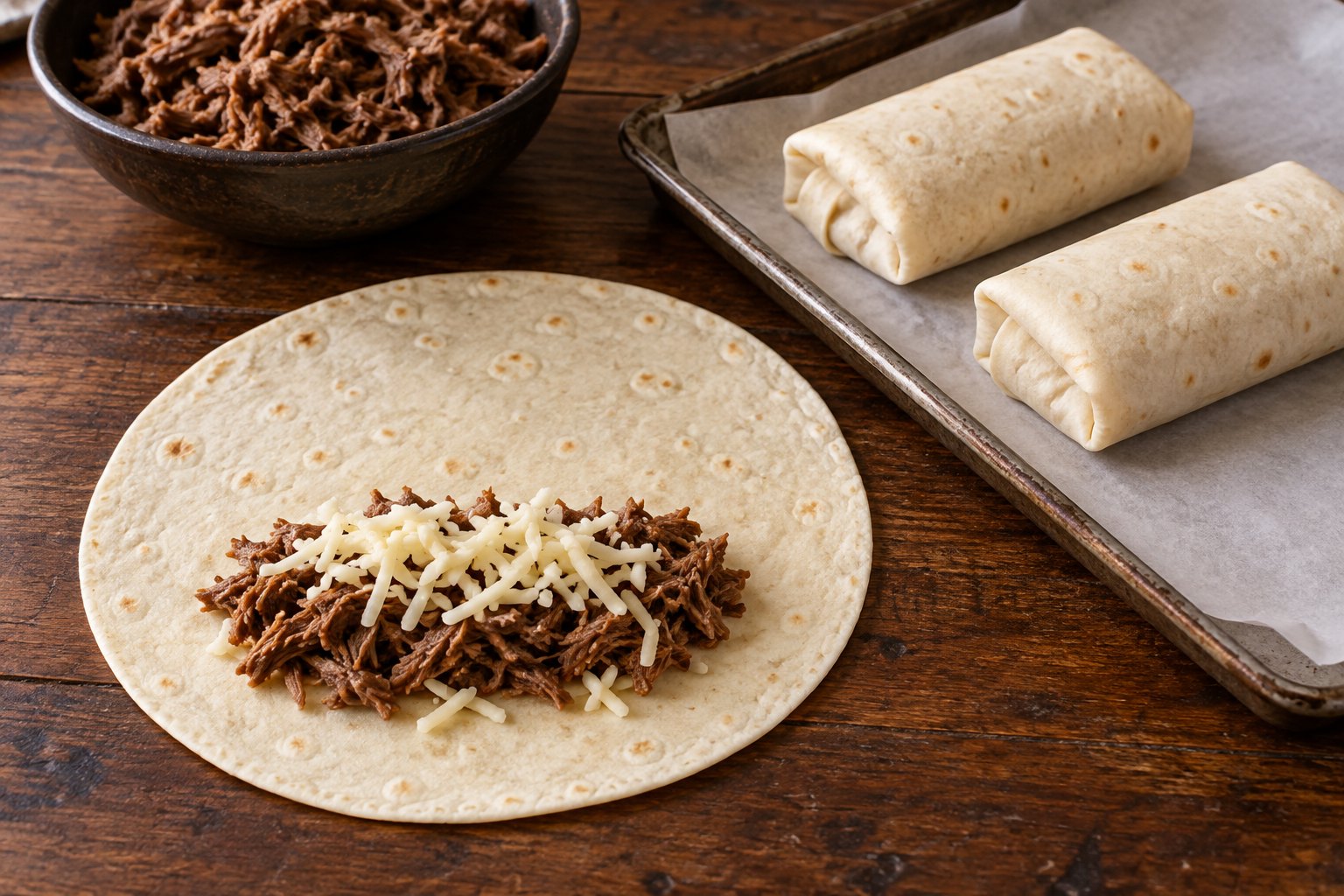
- Warm and fill the tortillas. Warm the tortillas briefly in a dry skillet or under a clean towel in the microwave just until flexible; avoid toasting them crisp. Divide the beef evenly among the four tortillas, placing it in a compact strip below each center and leaving generous clear borders. Add about ¼ cup cheese to each. If using our Homemade Flour Tortillas dough, divide that batch into four larger balls and roll each thin to about 10 inches; its standard 7-inch rounds are too small for this full-size filling.
- Fold tight and heat the oil. Fold both short side edges over the filling, then bring the near edge over it and roll into a snug closed packet. Rest each packet seam-side down; use one wooden toothpick through a stubborn seam if needed, and remember to remove it before serving. In a deep, dry, heavy skillet, heat about ¾ inch of neutral oil to 350°F (175°C). Keep the pan well below half full and use an oil thermometer. Never add water to hot oil or leave it unattended.
- Fry until evenly crisp. Lower in one or two chimichangas at a time, seam-side down, without crowding. Keep the oil near 350°F (175°C) and turn with tongs as the underside sets. Fry roughly 6 to 9 minutes total, turning to brown all faces, until the thin tortilla is crisp and evenly golden. The filling is already cooked; the oil is crisping the wrapper and heating the center. If browning happens much faster, lower the heat slightly.
- Drain and serve. Lift each chimichanga onto a rack over a tray so steam can escape and the bottom stays crisp. Remove any toothpicks. Let stand 2 to 3 minutes, then serve while hot. Put salsa, guacamole, pico de gallo, rice, and refried beans on the side; spoon sauce over only at the table if you prefer a softer restaurant-style shell.
What makes the crust work
Wet filling: reduce its juices until they cling to the beef, or the tortilla can split and spit in the oil. Open seam: use a warm flexible tortilla, leave a border, and begin frying seam-side down. Greasy shell: fry in small batches and let the oil return to about 350°F between them. Soft bottom: drain on a rack rather than leaving the hot packet on a flat plate. These are practical cooking cues drawn from the sources below; this exact formulation has not been kitchen-tested here.
Store and reheat
Refrigerate the cooked beef or finished chimichangas within 2 hours, or within 1 hour above 90°F (32°C). Keep leftovers covered at 40°F (4°C) or below and use within 3 to 4 days. Reheat a leftover chimichanga in a 375°F (190°C) oven on a rack until its center reaches 165°F (74°C); an oven helps restore some crunch. The USDA’s frying guidance explains hot-oil safety, and its leftovers guidance covers cold storage and reheating.
Understand it
A fried burrito needs a different balance
What separates a chimichanga from an ordinary burrito is the cooked wrapper: the flour tortilla becomes a crisp shell. That shell depends on three choices. The tortilla must be thin and flexible enough to fold without tearing; the filling should have enough concentrated juices to taste rich but no loose broth; and the oil must be hot enough to brown promptly without soaking the wrapper. Sunny Anderson’s recipe illustrates frying a sealed packet seam-first near 350°F, while the USDA explains why water and hot oil must be kept apart.
This base version uses chile-simmered chuck and Jack. For a chicken variation, replace the beef with about 3 cups fully cooked, shredded chicken and enough reduced cooking liquid to season without dripping; skip the long braise and heat the filling through before folding. For a bean-and-cheese variation, use about 2 cups thick, cool refried beans and the same 1 cup cheese, dividing both among four large tortillas. These are adaptations of the folding and frying method, not claims that one filling is original.
Know it
Arizona claims, uncertain beginnings
A chimichanga is closely associated with Arizona and the wider Sonoran border region, but the first cook is not established. El Charro Café in Tucson credits founder Monica Flin; Macayo’s in Phoenix claims a 1946 invention. Those are competing restaurant histories. The Arizona Historical Society describes the history as uncertain rather than certifying one inventor.
The Arizona Highways investigation records other oral accounts, including a mid-century sighting at a Tucson Pascua Yaqui Village booth. A recollection is evidence of circulation, not proof of origin. Read the full chimichanga story to compare the claims and their limits.
Sources and edition
How we built this version
This is a Border Table Research Edition. The beef filling, quantities, timing, and plating are an original home-cooking formulation informed by the sources below; this exact combination has not been independently cooked in our kitchen. The two food images are original AI-generated editorial illustrations. We do not claim a restaurant’s proprietary recipe, one definitive Arizona formula, or a proved inventor.
- Arizona Historical Society, Chimichangas — explicitly uncertain origin and regional context.
- Arizona Highways, Chimichangas: Whodunit First? — reported interviews, multiple claims, and historic recipe examples.
- El Charro Café menu and Macayo’s menu — each restaurant’s own attribution and current serving variations, not independent proof of invention.
- Sunny Anderson, Chimichanga Alamo — comparison for large tortillas, seam-side-first shallow frying, and temperature.
- USDA FSIS, Deep Fat Frying and Food Safety and Leftovers and Food Safety — oil and storage guidance.
Prepared 26 October 2026. Suggest a correction.