Food Stories · Arizona border kitchens
Where Did the Chimichanga Come From?
A fried burrito became an Arizona restaurant favorite. Its first cook and exact birthplace remain unsettled.
A chimichanga is recognizable at the first cut: a filled flour tortilla, folded closed and fried until the wrapper is crisp. Beef, chicken, beans, cheese, and chile can appear inside; sauces and cool toppings may arrive over the top or alongside it. The form is clear. The origin is not.
Two restaurants, two claims
El Charro Café’s account credits its founder, Monica Flin, known as Tía Mónica, with inventing the chimichanga. Its family story describes a burrito falling into hot oil. Macayo’s Phoenix menu calls its chimichanga a 1946 invention. Both restaurants continue to serve the dish. A restaurant’s account can document what its business says about its own past; it cannot by itself establish the first person ever to fry a filled burrito.
The details vary in retellings. Accounts of an accidental first frying have been told in more than one place, while Macayo’s keeps 1946 as its claim. We therefore give that year only as an attributed claim, not a settled chronology. The Arizona Historical Society explicitly calls the dish’s history uncertain and presents several competing explanations, including roots across the Sonoran border. None of those alternatives can be promoted to a proven single origin on the evidence reviewed here.
What the older accounts can tell us
In an Arizona Highways investigation, folklorist Jim Griffith recalled seeing a chimichanga sold at a Pascua Yaqui Village booth in Tucson around 1956 or 1957. That recollection is useful evidence that the dish circulated beyond one restaurant by the mid-century years. It is not a dated kitchen record of who invented it. The same article reports Sonoran and Tucson stories that conflict with one another.
Large flour tortillas and border travel matter to this account. A tortilla wide and pliable enough to enclose a filling can be folded shut and fried; the finished food then travels easily through restaurant menus, family tables, and regional adaptations. That practical relationship explains the dish better than treating one colorful accident story as established fact.
Why the plates do not all look alike
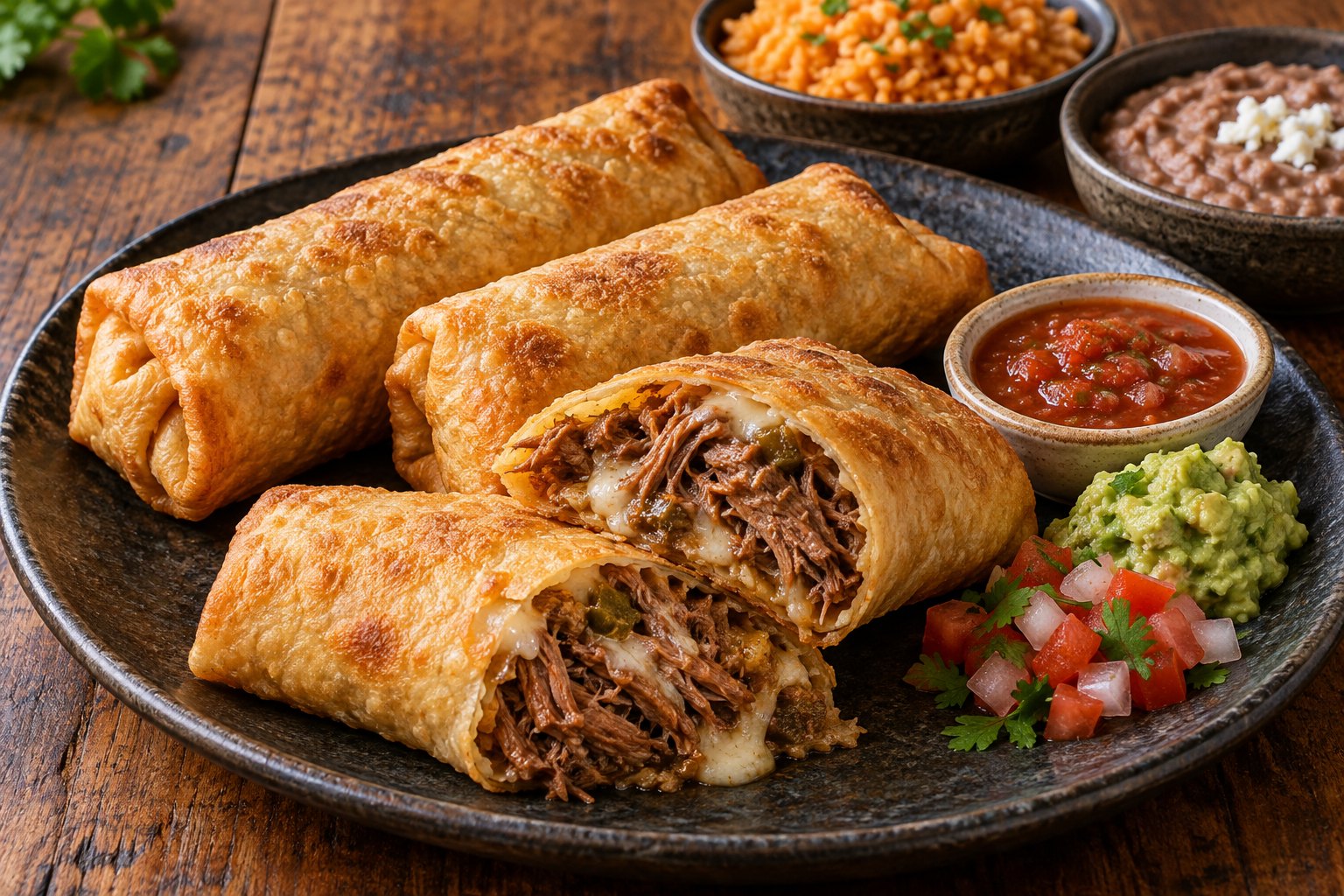
El Charro’s menu offers its carne seca burro in chimichanga style, while Macayo’s menu lists shredded beef, chicken, ground beef, and carnitas versions, often with sauce, pico de gallo, cheese, rice, and beans. These are evidence of living restaurant variations, not ingredients every chimichanga must contain. A sauced, plated chimi can be delicious, but sauce poured over the wrapper softens the crust. Our shredded-beef Chimichangas recipe puts salsa, pico de gallo, and guacamole alongside it so the first bite stays crisp.
The beef in that recipe is an original home-cooking choice. It is not El Charro’s carne seca, Macayo’s proprietary filling, or a recovered “first” formula. The measured method explains why the cooked filling must be moist but not dripping and why the tortilla needs a tight seal.
What the evidence supports
Documented: the named Arizona restaurants currently claim and serve their versions; the Arizona Historical Society describes the dish’s history as uncertain; Arizona Highways recorded multiple retrospective accounts. Not established: one inventor, one original kitchen, a certain year for the first chimichanga, or an exact path from Sonora to Arizona.
Cook the Chimichangas recipe · Browse Food Stories · Send a correction