Food Stories · Corn tortillas, chicken & red chile
Chicken Enchiladas: Red Chile, Corn, and the Table
A soft corn tortilla, cooked chicken, and a red sauce make a familiar plate. The history becomes more interesting when you follow the filling, the chile, and the way each cook brings them together.
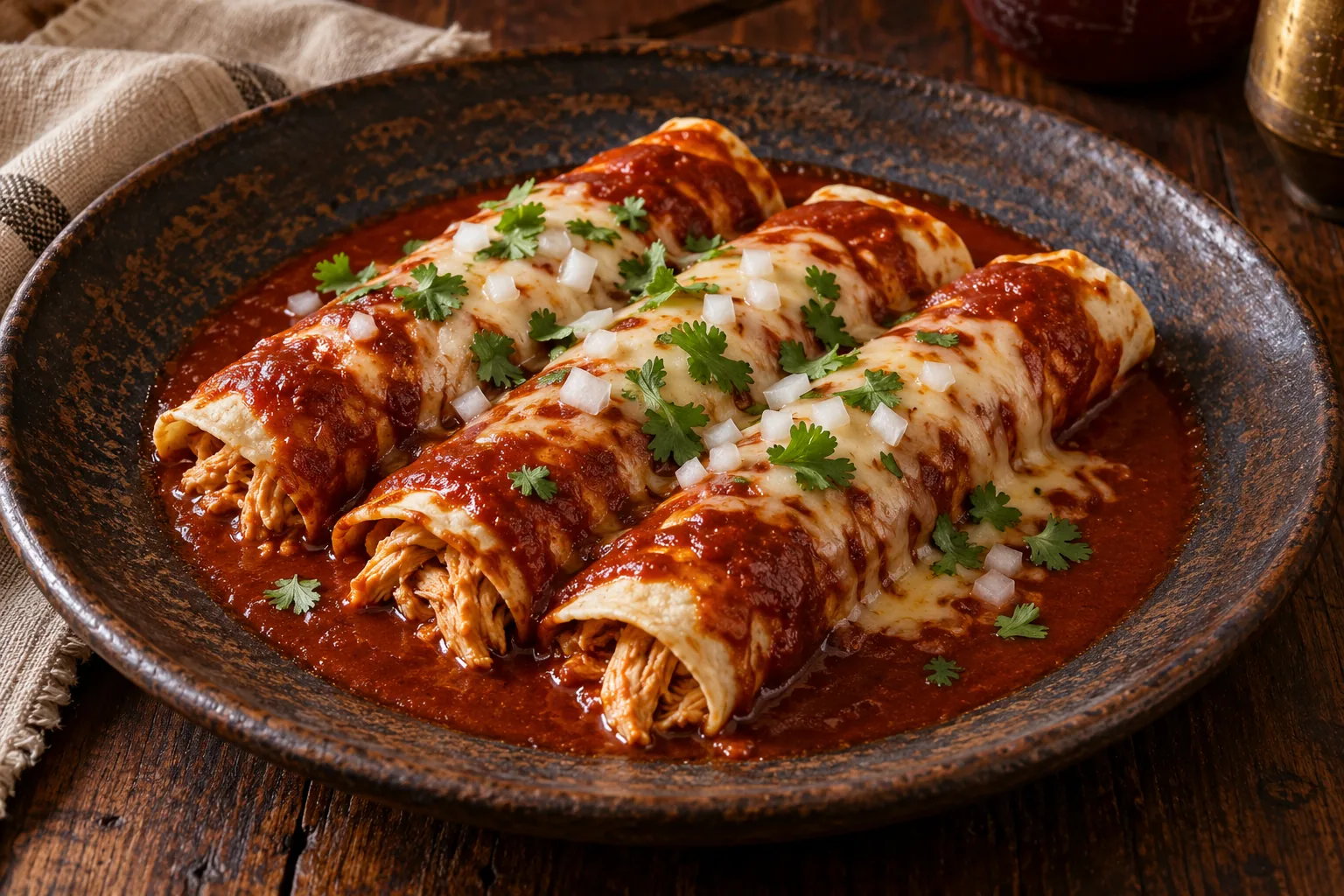
Begin with the chicken enchiladas you want to cook
The Border Table’s Chicken Enchiladas with Red Chile Sauce rolls thin white-corn tortillas around fully cooked shredded chicken. Its sauce blends guajillo and ancho with onion, garlic, broth, and Mexican oregano. Monterey Jack melts over the rolls; diced white onion and cilantro finish the serving.
This is the site’s home formula, developed through comparison with published methods. Its ingredient list is the starting point for your shopping and cooking. The separate Red Chile Enchilada Sauce is an older pantry preparation with a different ingredient list. You can explore both here without treating them as one recipe.
A rolled enchilada was already in print in 1918
UTSA Special Collections preserves a transcription of Alejandro Pardo’s Enchiladas al Estilo de Guadalajara, published in Los 30 Menús del Mes in 1918. The recipe fills tortillas with shredded pork and finishes a sauce with jocoque, which UTSA translates as Mexican-style sour cream. Its method ends with the hot sauce poured over the rolled tortillas on a platter. Read the 1918 recipe and UTSA’s interpretation.
The record supplies a date, an author, and an actual preparation. It does not date the invention of enchiladas or turn that pork recipe into a direct ancestor of this chicken dish. It also makes an important detail visible: filling and rolling a tortilla does not automatically mean finishing it in an oven. The cook’s sequence matters.
Larousse’s general definition describes corn tortillas coated in chile sauce, rolled or folded, usually with a filling, and notes regional variation. That broad description gives the dish a recognizable form while leaving room for different sauces and serving methods. Explore the Larousse definition.
Red describes a family of sauces
Larousse’s separate entry for enchiladas rojas describes red sauces made with tomato or dried chiles such as ancho and guajillo. It discusses preparations across several Mexican regions, including Zacatecas, Guanajuato, and Aguascalientes. The name identifies a broad family, not one fixed blend or filling. Read the regional reference.
For your kitchen, the useful questions are concrete: Which chile does the recipe name? Is chicken the filling or a separate accompaniment? Are the tortillas rolled, folded, or stacked? Is the sauce applied before frying, after rolling, or before baking? The complete recipe answers those questions more reliably than the color of a photograph.
Two published cooks show why the details matter
Rick Bayless’s published red-chile chicken enchiladas use guajillo and canned tomatoes in the sauce, cooked shredded chicken, corn tortillas, and melted cheese. His method strains the sauce and warms the tortillas before filling and baking. It is a useful practitioner comparison for the dish’s separate components. Read Bayless’s preparation.
Pati Jinich’s Enchiladas Mineras provide a different comparison. Her guajillo-coated tortillas fold around cheese and onion, with a dressed vegetable garnish. Her instructions call for a light coating of the sauce rather than the generous covering used on this site’s baked chicken dish. Read Jinich’s complete method.
These published recipes explain choices; they do not add ingredients to the recipe here. The Border Table’s chicken sauce includes ancho and Mexican oregano and has no tomato ingredient. Its tortilla-softening sequence and oven instructions belong to that same complete formula.
Know the dried chile before blending it
The University of California’s fresh-to-dried chile guide pairs mirasol with guajillo and poblano with ancho. Those names tell you which dried ingredient to buy. A whole dried pod, a powder, and a ready-made sauce have already passed through different kinds of preparation. Read the university guide.
New Mexico State University’s Chile Pepper Institute describes ancho’s dark, wrinkled appearance, mild heat, and dried-fruit character. That is an ingredient profile, rather than a promise that every finished sauce will have the same heat. Explore the Institute’s ancho sheet.
Use our guajillo guide and ancho guide to compare the pods. Then follow the chicken recipe’s brief toasting, soaking, blending, straining, and simmering sequence. In that method, warming a chile is different from blackening it; softening a pod is different from removing bits of skin with a sieve.
Keep the two red sauces distinct
- The chicken recipe’s sauce begins with whole guajillo and ancho chiles. Its complete page supplies the blend, liquid, filling, tortilla treatment, and baking instructions.
- The owner’s 2021 Red Chile Enchilada Sauce combines water, chili powder, paprika, salt, and prepared roux. Its short simmer belongs to a separate pantry-style sauce card. The source leaves the preparation of that roux unspecified.
The comparison helps you recognize two ways to build a red sauce. The archived sauce is additional reading, rather than a substitution instruction for the chicken recipe. The Cheese Enchilada story follows another distinct red-chile preparation, the rolled cheese plate, and its optional stack.
Read the Texas table through named records
Joe S. Graham’s Handbook of Texas account contrasts flat, layered enchiladas in West Texas and New Mexico with rolled meat-filled enchiladas associated with South Texas. Read that as a published regional description with room for individual cooks. It gives the El Paso and Paso del Norte atlas a useful comparison between serving forms, without assigning this home formula an El Paso origin. Read Graham’s account.
A Mi Tierra dinner menu marked 08/24 lists chicken enchiladas with green tomatillo sauce and chicken enchiladas in mole. On the same page, cheese enchiladas have chili meat gravy and Cheddar. This dated San Antonio restaurant record shows why naming the filling alone does not identify the sauce. Explore the menu’s enchilada page.
Continue to the San Antonio atlas for that city’s restaurant and public-table setting. The menu is a comparison, not the source of this site’s red-chile chicken recipe.
Bring the reading back to dinner
Open the complete Chicken Enchiladas recipe before you begin; it calls for chicken that is already fully cooked. Follow its own cooking cues and thermometer endpoint. The finished dish is twelve enchiladas for four servings, with three rolls per person as the page specifies.
Choose Mexican Rice or Refried Beans as separate sides if they suit your table. Compare the Texas Cheese Enchiladas when you want cheese and onion at the center. The recipes remain separate preparations; the stories and atlas help you understand the choices around them.
Sources and further reading
- UTSA Special Collections: Alejandro Pardo’s Guadalajara-style enchiladas, 1918 — a dated cookbook record and later interpretation.
- Larousse: Enchiladas and Enchiladas rojas — definitions and regional differences.
- Rick Bayless: Red Chile Enchiladas with Chicken and Melted Cheese — practitioner comparison.
- Pati Jinich: Enchiladas Mineras — a different filling and sauce treatment.
- UC Master Food Preserver: fresh and dried chile names — ingredient identification.
- NMSU Chile Pepper Institute: Ancho — the dried-poblano profile.
- Joe S. Graham: Tex-Mex Foods, Handbook of Texas — regional serving forms.
- Mi Tierra dinner menu marked 08/24, page four — a dated restaurant comparison.
Research reviewed 9 November 2026. The linked recipe pages retain their individual ingredients, methods, and source notes. Suggest a correction · Browse Food Stories.