Culinary Atlas · Mexico · Food, craft & community knowledge
Michoacán
Begin around Lake Pátzcuaro, then follow corn foods, copper work, and carnitas into a wider story of farmers, artisans, and cooks.
Carnitas is an inviting way into Michoacán’s food, but the landscape includes much more than pork. Corn preparations, lake foods, craft skills, and communal work give the region a fuller shape. Follow the Carnitas story alongside this article, then return to the Lower Valley recipe when you are ready to cook.
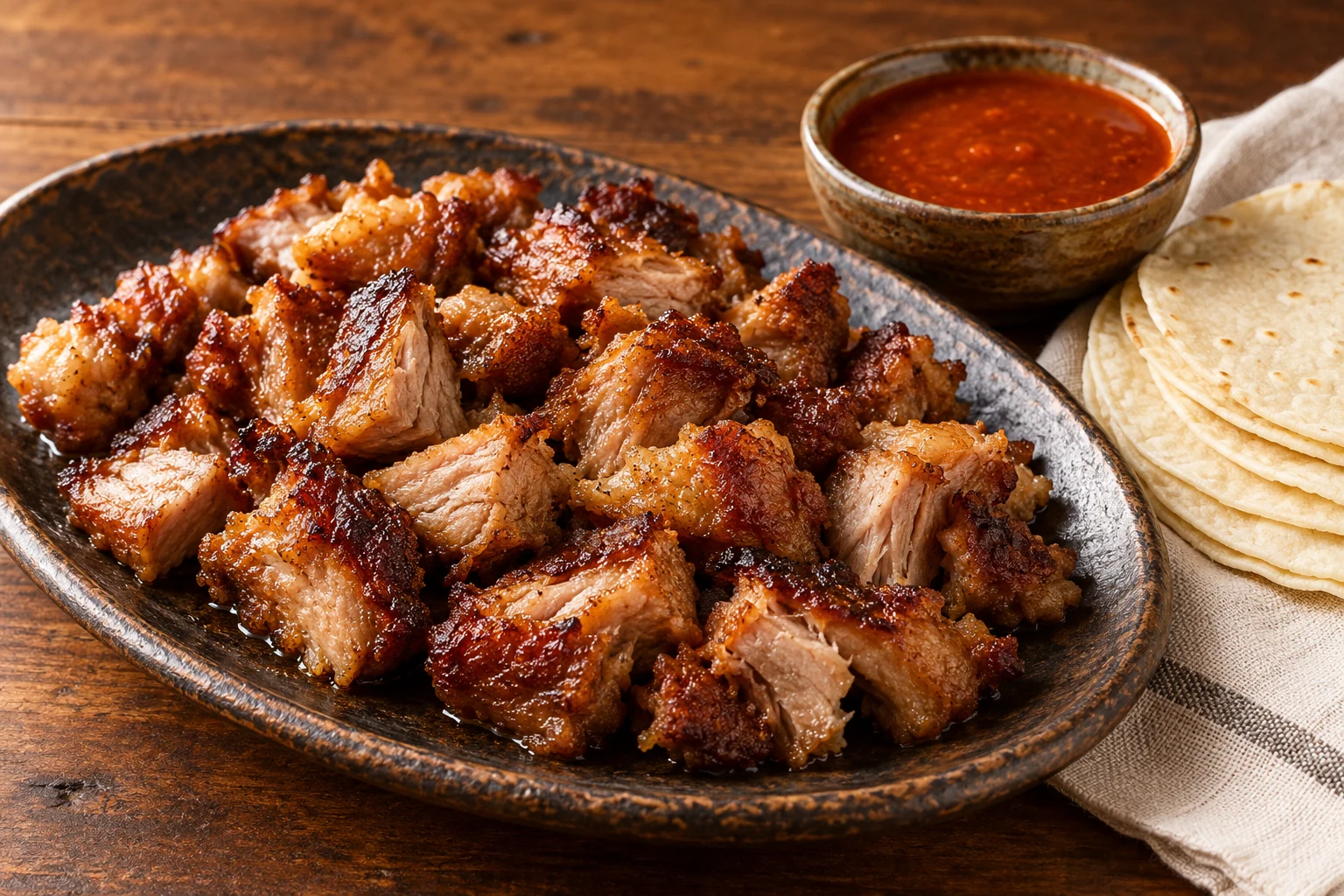
The illustration shows our associated Lower Valley Carnitas recipe. It is not an archival photograph or a claim to depict every Michoacán preparation.
Lake Pátzcuaro and a Purépecha capital
INAH’s account of Tzintzuntzan places the pre-Hispanic city beside Lake Pátzcuaro. It describes a Purépecha capital that was also a regional market, a center of craft production, and a place of political and ceremonial authority. Its terraces and distinctive temple bases, known as yácatas, remain part of the archaeological record.
The same account follows the transition into the colonial period: Indigenous elites and Spaniards occupied the older city during part of the sixteenth century, before settlement moved to lower ground toward the century’s end. These layers of changing power and settlement are part of the lake region’s history.
Archaeological remains and living food traditions tell different parts of that history. A city’s old market cannot, by itself, date the invention of a dish eaten there today. What it can do is remind us that the region’s places were centers of work, exchange, and decision-making long before a visitor arrived to order lunch.
Corn, lake foods, and regional differences
Mexico’s Sistema de Información Cultural survey of Michoacán emphasizes differences between the state’s food regions. Around the lakes it describes white fish and charales, the small fish used in tacos and other preparations. Its account gives those foods their own place beside the state’s pork dishes.
The survey also distinguishes several kinds of tamal. Corundas include corn preparations wrapped in leaves of the maize plant; uchepos use tender fresh corn. It describes further variations made with wheat, beans, fruit, and other ingredients. Highland and coastal wrappers differ, too, with banana leaves used for coastal examples. These are examples from the survey, not a single formula imposed on every household.
For the reader, that variety is useful. The grain, its stage of maturity, the wrapping, and the accompaniment all help identify what is on a plate. “Michoacán food” can orient us toward a place while still leaving room to ask which community, cook, and preparation we mean.
Quiroga: a town, a market, and more than one dish
The municipality’s own profile places carnitas alongside turkey barbacoa, beef head, charales, and corn-based foods such as corundas. It also describes woodwork, lacquered trays, fibers, textiles, and pottery, identifying Santa Fe de la Laguna with pottery and Purépecha culture. The food sits within a municipality of several communities and kinds of work.
The profile records the change from Cocupao to the name Quiroga in 1852. Its food and craft descriptions are useful for understanding the town’s public identity; they do not establish the first date on which someone cooked carnitas. Follow the story’s regional discussion for the distinction between a documented association and a dated invention account.
Santa Clara del Cobre: the work behind an object
In Santa Clara del Cobre, the Museo Nacional del Cobre presents a craft history extending from early Purépecha work to contemporary prize-winning pieces. The cultural-information record emphasizes hammered copper and the stages of making an object. That places skilled labor behind a material often noticed only as the color of a cooking pot.
For the carnitas connection, a 2025 state report describes both copper and stainless-steel cazos, or cooking pots, as well as slow cooking in lard. It names several regional centers, including Quiroga and Huandacareo. The vessel is one part of the preparation’s public identity, alongside ingredients and the work of cooking.
Our home recipe uses a heavy Dutch oven or deep, heavy skillet. Its instructions belong to that method and scale. The Carnitas story compares published approaches without asking you to replace the equipment or formula in the recipe you are following.
What the 2010 recognition includes
UNESCO’s original record lists Mexican culinary traditions in 2010, using the “Michoacán paradigm.” Its description includes farming, communal customs, cooking skills, and participation from planting through eating. Corn, beans, and chile are central. The record includes milpa agriculture, nixtamalization—the preparation of maize with alkaline lime—and tools such as grinding stones. These connect work in the fields with preparation in the kitchen.
The record also recognizes groups of women cooks and other practitioners in Michoacán and across Mexico, connecting food knowledge with community identity and social relationships. The recognition concerns a living food culture. It is broader than an award for a single plate of carnitas.
That changes the way we read a recipe. A list of ingredients is useful in the kitchen, while the atlas can also keep the growers, makers, and cooks in view. A regional dish is part of a set of relationships, and its continued life includes the people who teach, prepare, and share it.
Bring the place back to the kitchen
Our Carnitas comes from the owner-supplied “Lower Valley Carnitas” source identified on the recipe page. It gives you one complete shoulder recipe with its seasoning, covered stage, and milk finish. The Carnitas story explains how that source sits beside other published approaches.
Continue to the Rio Grande Valley atlas for the setting named in the cookbook attribution. The link connects two useful contexts; it does not turn the Lower Valley formula into a universal Michoacán recipe.
For a meal, follow the recipe’s tortilla choices through the corn-tortilla guide or Homemade Flour Tortillas, then choose a sauce from Restaurant-Style Salsas. The Jalisco atlas offers another western Mexican food landscape to explore through its own documented dishes and sources.
Sources and further reading
- INAH, Tzintzuntzan — the lakeside capital, market, craft production, and colonial transition.
- Sistema de Información Cultural, Michoacán gastronomy — lake foods, tamales, and regional differences.
- Municipality of Quiroga — town history, food, communities, and crafts.
- Sistema de Información Cultural, Museo Nacional del Cobre — the museum’s craft-history profile.
- Michoacán economic-development department, August 26, 2025 — regional carnitas centers and vessels described in the report.
- UNESCO, nomination file 00400 and its 2010 inscription record — the scope of the culinary-culture recognition.
Read the Carnitas story, cook the Lower Valley version, or return to the Culinary Atlas. Have a source that adds to the picture? Send a correction.