Food Stories · Citrus, spice, and the home table
Pollo a la Naranja: Orange, Spice, and the Home Table
Orange juice, a little cinnamon and clove, capers, and almonds give this chicken its character. Follow the written comparisons and the South Texas citrus landscape, then return to the complete recipe.
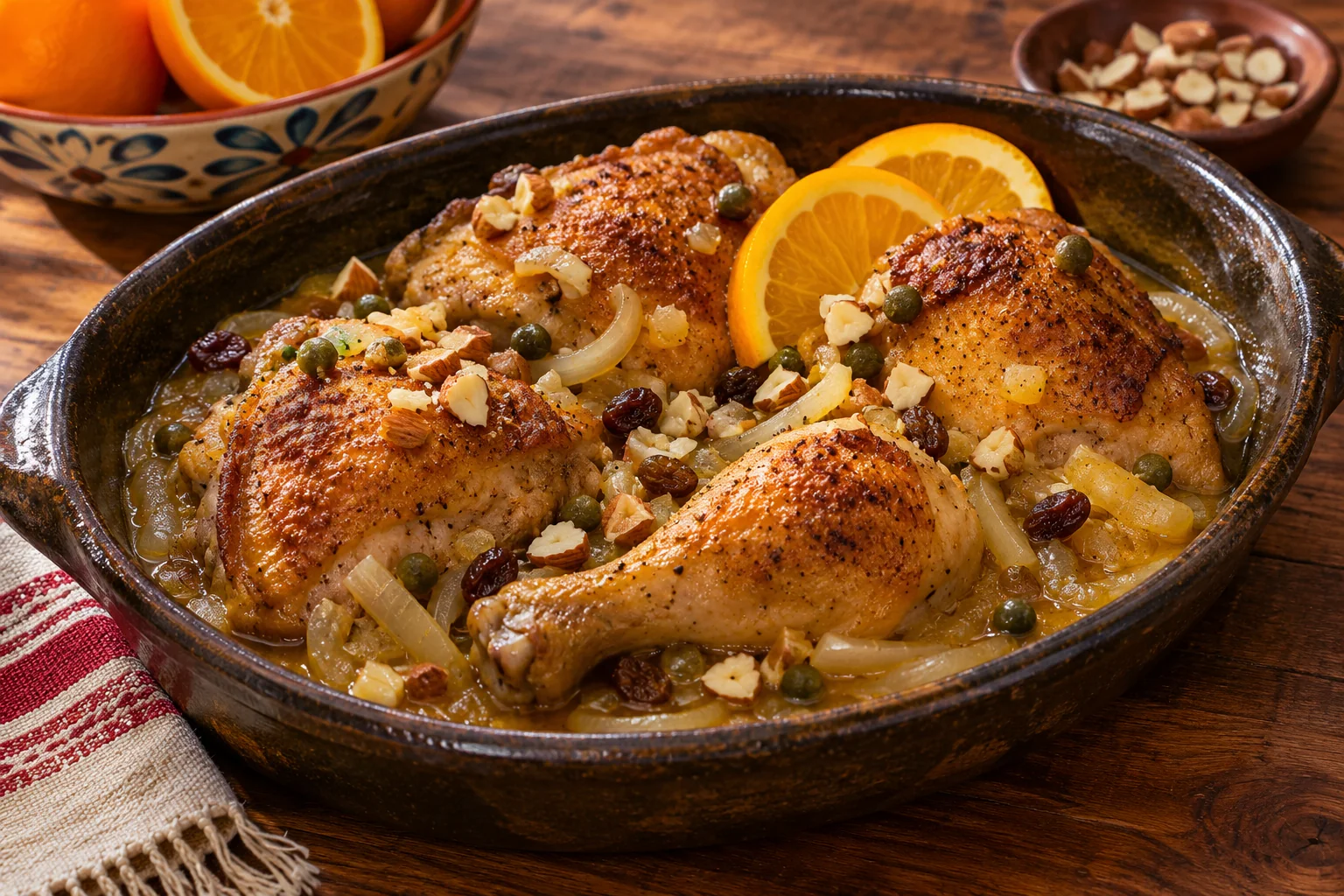
Start with the chicken on this table
Our Pollo a la Naranja comes from the founder’s 2021 recipe collection. It begins with bone-in chicken pieces, browned with a little cinnamon and clove. Orange juice and water become the cooking liquid; onion, whole garlic cloves, and capers join the pan. Chopped almonds enter near the end, and peeled Valencia orange slices finish the serving dish.
Saffron and raisins are optional in that record. The chicken, orange, warm spices, capers, and almonds establish the preparation even when those two additions are left out. Read the complete recipe for its proportions and sequence: this is a covered, gently cooked chicken dish with a pan sauce.
Chicken, almonds, and warm spices have a written record
UTSA Special Collections presents Pollo en Salsa de Almendra from Ramona Valdes’s Cocina práctica (Mexico, 1937), pp. 232–233. Its transcription brings chicken together with almonds, cinnamon, and clove. Bread and tomatoes also enter the sauce, which is ground before it coats a whole chicken for the oven.
That example helps place the savory use of almonds and warm spices within a named Mexican cookbook. Our orange-braised chicken keeps the almonds as chopped pieces and uses a different liquid and cooking sequence. The two preparations can be read side by side without turning the older book into an origin claim for the founder’s recipe. The comparison here uses UTSA’s transcription and translation.
A name can describe several different preparations
Look beyond the words pollo a la naranja when choosing a recipe. The Mexican agriculture ministry’s April 23, 2023 recipe with that title uses cubed chicken breast and an orange sauce containing soy sauce, vinegar, sugar, and cornstarch. Its cooking instructions develop that sauce in the skillet.
The founder’s version follows bone-in pieces through browning and a covered braise, with capers and almonds among its distinguishing ingredients. Reading the cut, liquid, and finishing ingredients tells you more about the meal than the shared title alone. Neither the modern ministry recipe nor the 1937 almond preparation documents where this exact home formula began.
Follow the orange into the South Texas landscape
Citrus opens another useful route through the food’s setting. The Texas Department of Agriculture’s January–February 1925 bulletin, The Citrus Industry in the Lower Rio Grande Valley of Texas, is preserved by UNT Libraries. Its catalogue identifies a publication devoted to the developing regional industry. It is an agricultural record alongside the household recipe.
UNT’s 2018 guide to citrus in its borderlands newspaper collection follows growers, markets, and promotion through older newspapers. It names TexSun orange juice in Weslaco among the regional products. Those records make the fruit’s journey through cultivation and commerce visible, beyond the moment when a cook squeezes it into a pan.
The Rio Grande Valley atlas supplies the wider river, ranch, and irrigated-field setting. This is an ingredient connection to a place. The founder’s record does not assign the chicken recipe to a particular Valley town, and the citrus evidence does not establish its birthplace.
Read the sequence as carefully as the ingredients
The recipe moves from browning to gentle covered cooking. That change in method explains the form of the finished dish: browned chicken sitting in its cooking liquid, with visible almonds and capers. The tiny measures of cinnamon and clove are part of the savory seasoning. Keep the whole garlic cloves recognizable so they can be removed as the instructions direct.
The fresh orange slices and the juice also have different jobs. Juice goes into the cooking liquid; the peeled slices surround the finished chicken. The chopped almonds arrive near serving rather than being ground into the sauce, as in the separate 1937 comparison. Those choices are part of this recipe’s identity.
The cooking page retains the thermometer endpoint and the full directions for the chicken pieces. For the cut itself, browse Meat, Poultry & Cuts. Follow the onion entry for a fresh ingredient in the pan, and the herbs-and-spices collection for the pantry side of the meal.
Cook the chicken, then choose the rest of the table
Return to Pollo a la Naranja for the complete recipe and its approved serving image. Mexican Rice offers a separate accompaniment, and the Rice story follows the grain and its cooking choices.
For a different use of pantry seasoning, read Texas Dry Rub: Chili Powder and the Seasoned Steak. It returns to its own four-ingredient preparation. Continue through Food Stories to choose another dish, or explore the atlas through a place that interests you.
Sources and further reading
- The Border Table, Pollo a la Naranja — the founder’s 2021 recipe and the complete cooking method.
- UTSA Special Collections, Pollo en Salsa de Almendra — transcription and translation from Ramona Valdes, Cocina práctica (1937), pp. 232–233.
- Secretaría de Agricultura y Desarrollo Rural, Receta de temporada: Pollo a la naranja — a different preparation published April 23, 2023.
- UNT Libraries, The Citrus Industry in the Lower Rio Grande Valley of Texas — catalogue record for Texas Department of Agriculture Bulletin 79, January–February 1925.
- UNT Libraries, Citrus History in the Borderlands Newspaper Collection — June 15, 2018 guide to historical newspaper examples.