Food Stories · Home cooking and restaurant tables
Carne Guisada at the South Texas Table
Tender beef, gravy, and warm tortillas connect home kitchens with neighborhood restaurants. Follow the documented accounts, then return to the founder’s chuck-roast version.
Carne guisada is a stew, and on this site its identity is specific: tender cubes of chuck roast in a dark gravy, with onion and garlic, and no bell pepper or tomato. The complete recipe is the founder’s version from his 2021 collection. The story around it includes other cooks and other versions, each with its own choices.
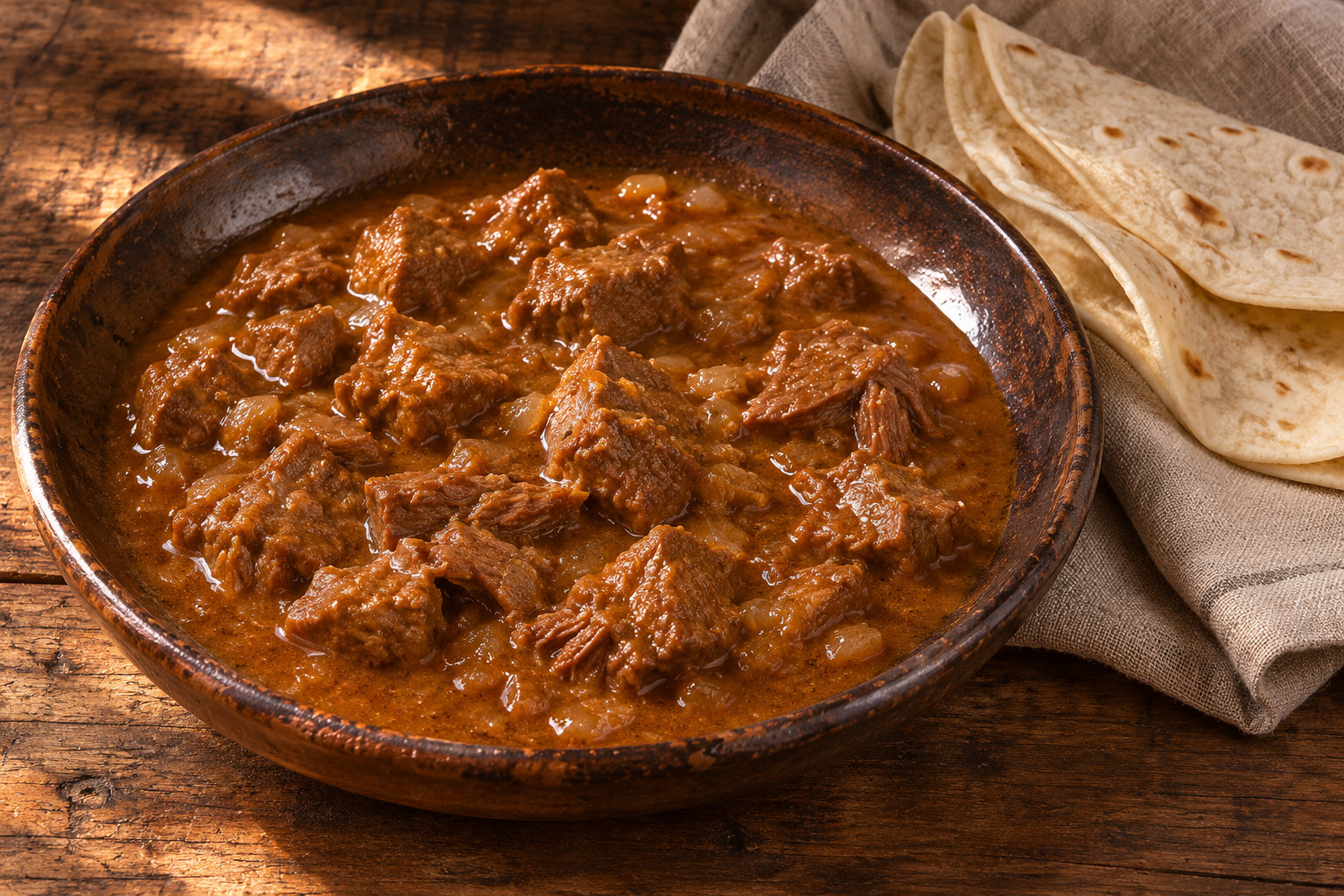
Comida casera: the place of a familiar pot
In his own writing about carne guisada con papas, chef Adán Medrano places the dish in the home cooking of Mexican American families in Texas. His published version uses potatoes and serrano chile, with a seasoning paste and flour to thicken the cooking liquid. It is one named cook’s preparation.
Medrano also describes South Texas food through comida casera, or home cooking, in E. Dan Klepper’s September 2019 Texas Highways reporting. The article places carne guisada among the region’s continuing foods. These accounts give the stew a place in everyday cooking without requiring an inventor’s name or a single fixed ingredient list.
There is a wider historical vocabulary behind that pot. Joe S. Graham’s Handbook of Texas account records guisados, or stews, among Texas Mexican meat preparations, including uses of dried meat. That broader category provides context; the founder’s fresh-chuck recipe has its own ingredients and method.
A diner meal carried into another generation
In the New York Department of State’s World Heritage Day cookbook, page 6, contributor Michelle Rosales recalls growing up in San Antonio and eating carne guisada with her grandmother at a small Mexican diner. She remembers the stew in homemade flour tortillas with avocado, and describes making it for her own family as an adult.
Her recollection gives the story a concrete route between a restaurant table and a home kitchen. It is a personal account with a named author, rather than evidence that every family served the stew the same way. The accompanying ingredient list is also her version; it is separate from the chuck-roast recipe published here.
What a reported restaurant visit shows
Paula Disbrowe’s June 2020 visit to Garcia’s Mexican Food describes carne guisada served with peppery gravy and fresh flour tortillas. Her account identifies a family business in San Antonio and records John Garcia emphasizing a simple, spice-led simmer. It documents a particular restaurant’s dish at the time of the visit.
The same report discusses gravy thickened with a roux. On the founder’s recipe page, flour is stirred into cooking liquid and added near the end. Those are different thickening sequences. Reading the actual method matters more than assuming that a shared dish name means every cook begins with the same pot.
These examples also show why a familiar food can have more than one setting. The dish belongs to the work of cooking at home, the routines of a neighborhood diner, and the restaurant menu. Each account records a different part of that life.
Where the Rio Grande Valley connection belongs
The founder’s version reflects his Rio Grande Valley cooking and was part of this site’s 2021 collection. He has identified Carne Guisada and Beef-Cheek Barbacoa as two of his favorites. That personal connection is the reason the two recipes sit together at The Border Table.
For the wider setting, UTSA Special Collections’ regional cuisine overview describes continuing ties between Texas and the northern Mexican states of Coahuila, Nuevo León, and Tamaulipas. Our Rio Grande Valley atlas follows the local river, ranching, farming, and remembered meals. The Reynosa and Tamaulipas article continues across the river.
The San Antonio accounts above help establish the stew’s wider South Texas life. The founder’s Valley connection comes from his own cooking. Keeping both in view lets a regional story include several places without assigning one town an unsupported claim to the dish’s invention.
The founder’s version keeps the chuck in cubes
Our Carne Guisada recipe begins with diced chuck and a browning stage, then uses a long, gentle simmer. Onion, garlic, and the specified seasonings contribute to the gravy. The cooking liquid stays in the pot, and the flour slurry goes in near the end.
The finishing cue is tender pieces of beef in a gravy that can be spooned onto a tortilla. This version contains no bell pepper or tomato. Follow its own seasoning quantities, timing, and order rather than combining them with the different published versions discussed in this story.
Compare that result with the Beef-Cheek Barbacoa story: the cheek cooks in larger pieces and is pulled after it becomes tender. Our chuck roast and beef-cheek notes connect each cut to its own recipe. The difference is useful when deciding what to buy and which method to follow.
A tortilla at the table, or a combination plate
For a simple meal, put the stew beside warm Homemade Flour Tortillas and let each person fill a tortilla. The flour tortilla guide explains keeping a stack warm and pliable. If you want a fuller plate, Mexican Rice and Refried Beans are separate recipes with their own methods.
The Texas Combination Plate story follows that restaurant format through its own documentary sources. It offers another way to think about a meal assembled from distinct preparations. Return to the Carne Guisada recipe whenever you need the measured ingredients or cooking sequence.
Read the cooks and the records
- The founder’s published 2021 Carne Guisada recipe and stated Valley cooking connection — the version served at this table.
- Adán Medrano, Carne Guisada con Papas — his description of comida casera and his own distinct preparation.
- E. Dan Klepper, Texas Highways, September 2019 — Medrano’s South Texas home-cooking account.
- New York Department of State, World Heritage Day cookbook, page 6 (PDF) — Michelle Rosales’s attributed San Antonio recollection.
- Paula Disbrowe, “We Brake for Queso,” June 2020 — a firsthand visit to Garcia’s and its carne guisada.
- Joe S. Graham, Handbook of Texas: Tex-Mex Foods and UTSA Special Collections — the wider regional context.
These sources describe particular cooks, memories, and regional practices. They do not establish a sole inventor or authenticate the founder’s recipe as a restaurant formula.
Cook Carne Guisada · Explore the Valley · More Food Stories · Suggest a correction