Food Stories · Cookies, place & memory
Pan de Polvo: Cookies, Memory, and South Texas Tables
A small cookie can hold a very particular memory. Pan de polvo connects South Texas baking tables, cinnamon-sugar finishes, and the different recipes people learn to recognize as their own.
Start with The Border Table’s Pan de Polvo recipe for the complete pecan-and-egg version. Then follow the evidence here: a university archive, an Edinburg baker’s account, and published descriptions of related cookies. They explain a tradition with many expressions rather than one compulsory formula.
One cookie name does not settle every recipe
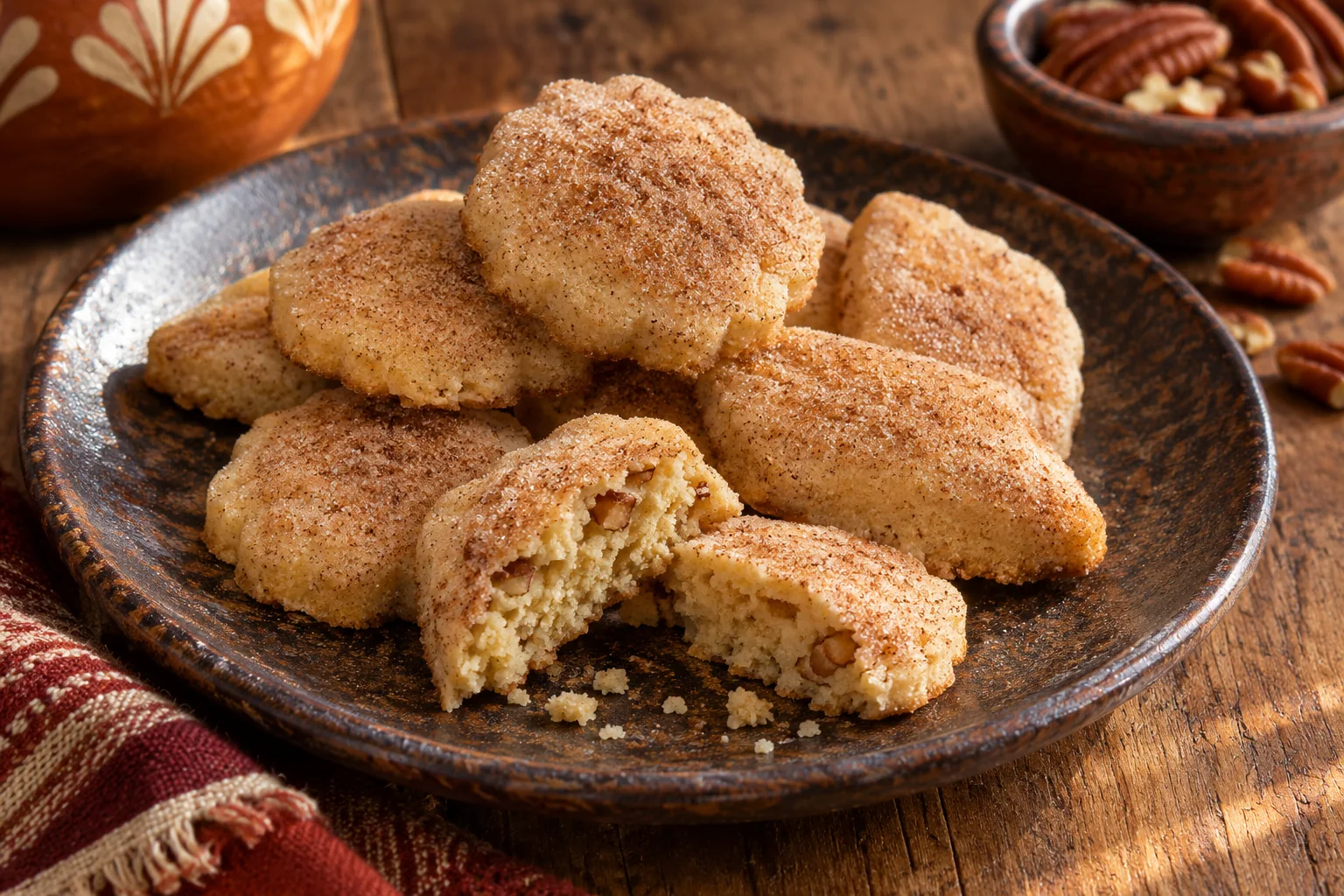
Pan de polvo on this site is a small cut cookie with finely chopped pecans, shortening, eggs, and a cinnamon-sugar coating. The name should help you find the food; it should not erase the differences between bakers.
Larousse Cocina’s Mexican gastronomic dictionary describes hojarasca as a fragile, dry cookie containing lard, flour, and cinnamon, and associates that entry with Coahuila, Michoacán, and Nuevo León. That reference offers a useful comparison, not a ruling that every cookie called pan de polvo must contain those ingredients. Read the hojarasca entry in Larousse’s bread dictionary.
A regional name and an ingredient list answer different questions. The name tells you how a baker identifies the food. The list tells you which version you are actually making. On this site, pecans and eggs belong to the recorded recipe; lard does not replace the shortening simply because another source describes a lard-based cookie.
The holiday connection has named voices
In his Texas Highways account of Tejano Christmas traditions, Luis G. Rendon remembers his tía Elma’s star-shaped hojarascas in Laredo. The same article interviews Jason Hernandez of Nani’s Cookies in Edinburg, who recalls his mother filling cinnamon-cookie orders and describes carrying her recipe into his own baking. These are attributed accounts of family practice, not a shared origin date. Read Rendon’s reporting and memories.
Edinburg gives the story a direct Rio Grande Valley connection. Laredo is a different South Texas city. Keeping those places distinct lets a reader follow the food without turning the whole border into one interchangeable kitchen.
Cookbook author Melissa Guerra also writes about finding her grandmother’s cookies in pantry tubs. In her own preparation, she compares cookies made with a press to those rolled and cut by hand. Her separate pecan-pan-de-polvo article identifies the nut-bearing variation with South Texas Christmas baking. These are published examples of choices within the tradition, rather than evidence that all families use pecans. Read Guerra’s family account and her pecan variation.
These accounts make the cookie’s history tangible through people, shapes, and occasions. The evidence is strongest when a memory stays attached to the person who supplied it.
What the university archive can tell us
The University of Texas Rio Grande Valley catalogs a Pan de Polvo folder in its Traditional Mexican American Folklore food collection. Its title dates the records to 1980–1993. The university also catalogs a separate empanada folder. The two entries show these foods being collected as part of Mexican American food knowledge; neither title dates the invention of the dish. Explore the Pan de Polvo catalog record.
An archive is especially valuable for this kind of food because familiar baking may travel through household instruction as well as published books. Here, the catalog is evidence of a preserved record. It does not establish that The Border Table’s 2021 recipe came from that folder, that every contributor lived in the Valley, or that one town created the cookie.
The pecan-and-egg version at The Border Table
The owner’s recovered 2021 recipe supplies the dough, small cut shapes, baking range, and warm cinnamon-sugar coating. It does not identify a family baker or a regional birthplace. That is the lineage of the complete recipe you can cook here.
Read the dough and the finish as two separate parts. Sugar is mixed into the flour before shortening is cut in; finely chopped pecans and beaten eggs complete this dough. The cookies are rolled to the thickness recorded on the recipe page, cut small, baked, and coated while warm. The source does not specify a quantity or ratio for the cinnamon-sugar coating. The recipe keeps that gap visible rather than presenting a newly invented measure as part of the old card.
For planning your table, remember that this version includes wheat, eggs, and pecans. The sugar entry in Kitchen Essentials helps distinguish dough sugar from a finishing coat. Kitchen Foundations connects the cut-cookie method to the separate filled-pastry preparation.
Follow a cookie to another part of the table
Choose the Rio Grande Valley atlas for Edinburg’s place in the published account and the university’s food archive. Continue to the Pineapple Empanadas story for Harlingen bakery reporting and a different writer’s memories across the border.
If you want a second bake, the Pineapple Empanadas recipe uses a filled, folded pastry with preserves. The two recipes share a cinnamon-sugar finish, but their doughs, shapes, and methods remain separate. The San Antonio atlas opens another path into bakery counters and restaurant tables, without assigning a San Antonio origin to this cookie.
Sources and further reading
- UTRGV, Pan de Polvo folder, 1980–1993 — catalog dates describe records.
- Luis G. Rendon, Tejano holiday traditions, Texas Highways — Laredo memories and Edinburg reporting.
- Melissa Guerra, Traditional Pan de Polvo — household account and shaping comparison.
- Melissa Guerra, Pecan Pan de Polvo — a named pecan variation.
- Larousse Cocina, Pan — the dictionary’s hojarasca entry.
The linked recipe preserves the owner’s 2021 formula. Research reviewed 9 November 2026. Suggest a correction · Browse Food Stories.