Source Edition · San Antonio Tex-Mex
Mi Tierra’s Chile con Queso
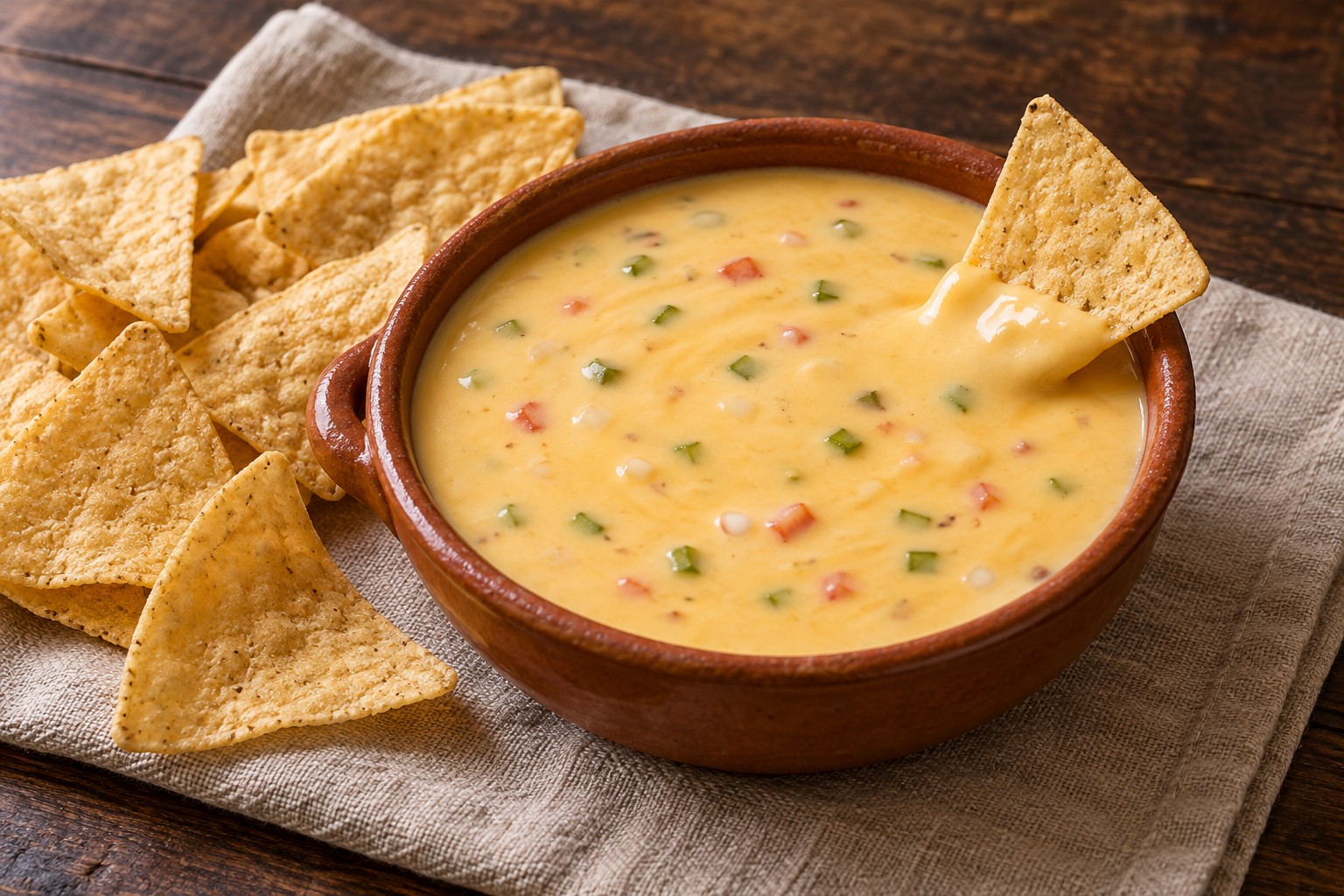
A smooth, warm queso where processed cheese supplies the creamy foundation, sharp cheddar adds character, and finely minced jalapeño, tomato, and onion bring freshness without turning the dip chunky.
Method
- Prepare the ingredients. Cut the Velveeta into small, even pieces; grate the cheddar; and finely mince the jalapeño, seeded tomato, and onion. Have everything ready before the cheese goes over the heat.
- Melt the cheeses gently. Set a heatproof bowl over a saucepan containing about 1 inch of barely simmering water, making sure the bowl does not touch the water. Add both cheeses and stir often until they are melted and mostly smooth, 5 to 7 minutes. Keep the heat gentle and do not let the water boil hard.
- Add the cream. Pour in the heavy cream a little at a time, stirring continuously, until the queso is smooth and glossy. If it seems too thick for dipping, add another tablespoon of warm cream.
- Finish the queso. Fold in the minced jalapeño, tomato, and onion. Continue heating and stirring for 1 to 2 minutes, just until the vegetables lose their raw chill and the dip is hot.
- Serve warm. Transfer a small amount to a warm serving bowl and keep the remainder warm over very low heat or in a slow cooker on its warm setting. Stir occasionally and serve with tortilla chips or Fritos corn chips.
Before you start
Use low, indirect heat. The double boiler gives the cheddar time to melt into the processed cheese and cream without scorching or separating. Freshly grated cheddar melts more evenly than cheese coated with anti-caking powder.
Cut the vegetables finely. They should punctuate the smooth queso, not turn it into a chunky salsa.
Microwave option
Combine the cheeses in a microwave-safe bowl. Heat at 50 percent power in 30-second intervals, stirring thoroughly after each interval. When melted, stir in the cream, then the jalapeño, tomato, and onion. Continue in short intervals only until hot and smooth.
Rescue and common mistakes
If the queso is too thick, stir in warm cream 1 tablespoon at a time. If it begins to look oily, take it off the heat and stir steadily while it cools slightly; aggressive heat is usually the cause. If it cools and tightens at the table, return it to gentle heat rather than adding a large amount of cold liquid.
Holding and leftovers
For a gathering, hold the finished queso at 140°F or warmer and refill a small serving bowl as needed. Refrigerate leftovers in a shallow covered container within 2 hours and use within 3 to 4 days. Reheat on the stovetop or in the microwave to 165°F, stirring often; do not use a slow cooker to reheat cold leftovers. Once hot, it may be transferred to a preheated slow cooker on warm.
Understand it
Why the two cheeses work together
Processed cheese provides a stable, smooth base that stays creamy over gentle heat. Sharp cheddar supplies a fuller cheese flavor but can become grainy or oily when overheated. Cream loosens the mixture to dipping consistency, while the small amount of vegetables adds brightness without overwhelming the emulsion.
Know it
A San Antonio restaurant recipe in print
Robb Walsh published this formula as “Mi Tierra’s Chile con Queso” in The Tex-Mex Cookbook. Mi Tierra Café y Panadería traces its San Antonio Market Square roots to Pedro and Cruz Cortez’s three-table café in 1941. This Source Edition attributes the printed recipe; it does not claim to disclose the restaurant’s current kitchen formula.
About this edition
The source’s six-ingredient queso remains intact: Velveeta, sharp cheddar, heavy cream, jalapeño, tomato, and onion. This edition chooses the source’s double-boiler option as the clearest primary method and adds preparation size, visual cues, a microwave path, rescue guidance, and current food-safety handling. It is carefully rewritten from the supplied scan and ready to cook, but the exact revision has not yet been tested in The Border Table kitchen.
Sources
Where this edition comes from
- Robb Walsh, The Tex-Mex Cookbook (Ten Speed Press, 2004), p. 202, “Mi Tierra’s Chile con Queso.” Owner-supplied scan reviewed September 21, 2026.
- Penguin Random House: The Tex-Mex Cookbook — author, publisher, publication date, and scope.
- La Familia Cortez: How It All Began — the restaurant family’s account of its 1941 San Antonio beginning.
- Mi Tierra Café y Panadería dinner menu — confirms chile con queso as a current menu item, not the details of the published formula.
- USDA FSIS: Leftovers and Food Safety — hot holding, prompt refrigeration, storage, and reheating guidance.