The Border Table · Research Edition
Tres Leches Cake
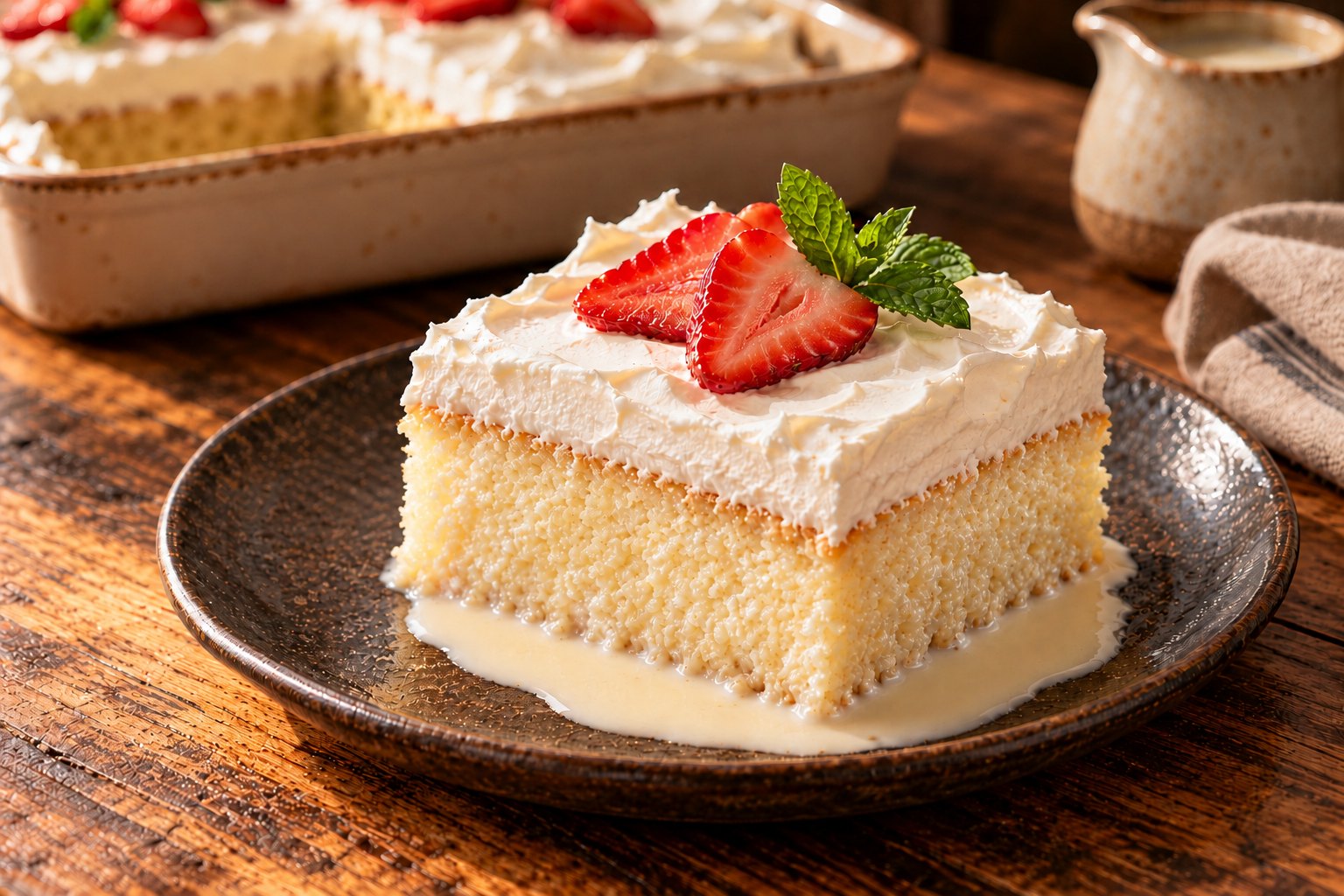
A chilled vanilla sponge that holds three milks in every bite, with a soft whipped-cream finish.
The cake is deliberately light before the soak; after a long chill, it should slice cleanly and taste lush and creamy.
Make the cake
Before you start: Use a deep baking dish because the sponge rises before it is soaked. Set out the eggs to lose their chill, and keep the cream cold for whipping.
- Ready the pan and dry ingredients. Heat the oven to 350°F (175°C). Lightly oil a 9 × 13-inch baking dish at least 2 inches deep. Whisk the flour, baking powder, and salt together until evenly combined. Set a rack in the middle of the oven.
- Whip the whites. In a clean, dry bowl beat the egg whites until foamy. Add 100 g of the sugar gradually and beat until glossy medium peaks hold their shape but do not look dry. Set aside.
- Build the sponge batter. In another bowl beat the yolks with the remaining 100 g sugar until pale, thick, and ribboning from the beaters, about 4 to 5 minutes. Beat in the water and 2 teaspoons vanilla. Fold a large spoonful of whites into the yolks to loosen them. Fold in the flour mixture and remaining whites in alternating additions, gently turning the bowl until no dry flour or white streaks remain.
- Bake and cool. Spread the batter evenly in the prepared dish. Bake for about 28 to 32 minutes, checking at 26 minutes. The top should be light gold and spring back at the center; a toothpick should come out clean or with a few dry crumbs. Cool in the dish on a rack until no longer warm, about 45 minutes.
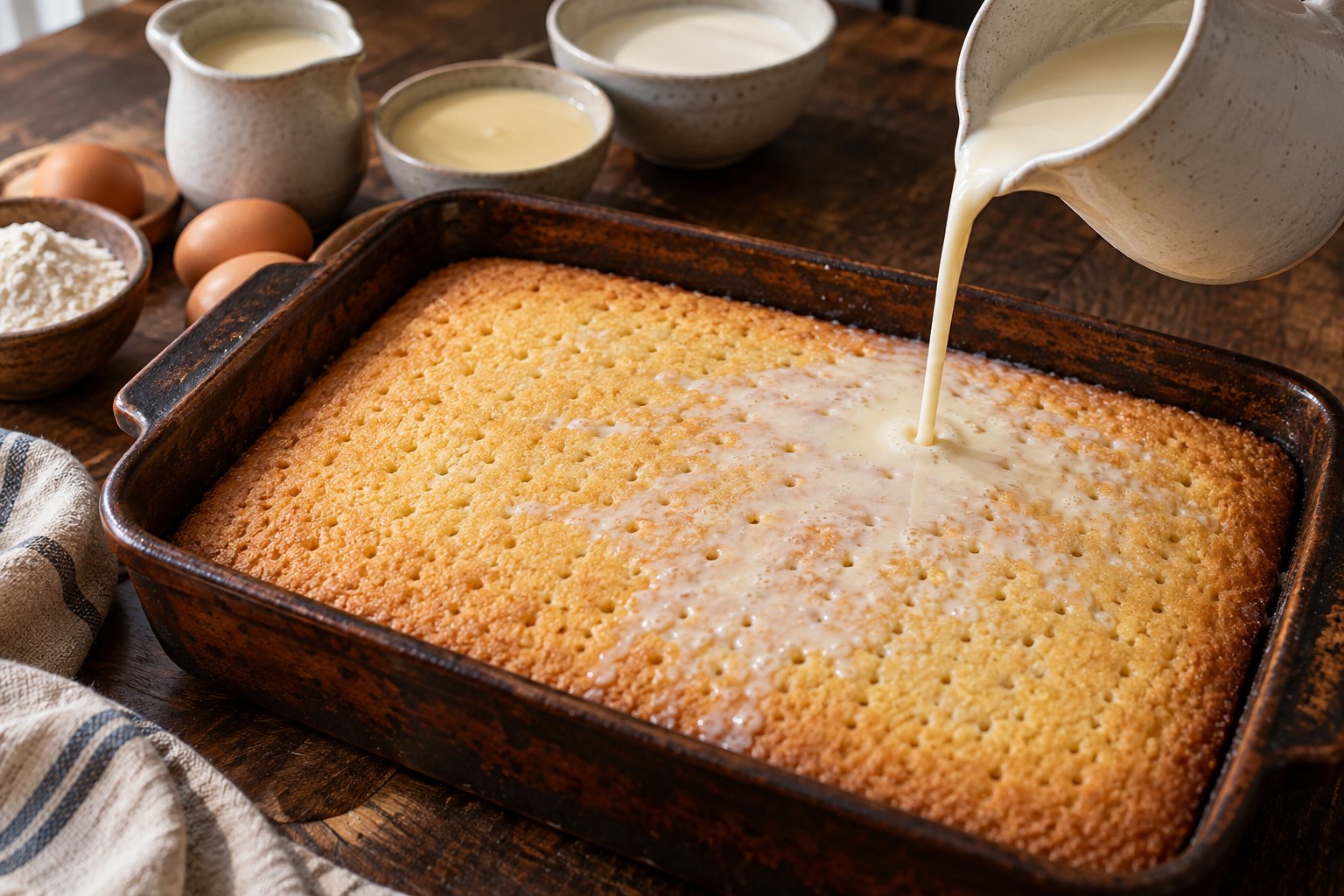
- Make the three-milk soak. Whisk the condensed milk, evaporated milk, 1 cup heavy cream, and 1 teaspoon vanilla until completely smooth. Prick the cooled cake across the entire surface with a skewer or fork, spacing holes roughly an inch apart and reaching nearly to the bottom.
- Soak in stages. Slowly pour the milk mixture over the cake in three passes, covering the edges as well as the center. Pause between passes so the liquid can sink in. A little liquid may gather at the edges; wait for it to absorb before adding the rest. If the dish is too shallow to hold every drop, refrigerate any extra soak separately and spoon it onto individual slices.
- Chill thoroughly. Cover the cake and refrigerate promptly for at least 4 hours, preferably overnight, until the milk is absorbed and the cake is cold.
- Whip, finish, and serve. Just before serving, beat the 1½ cups cold cream, confectioners’ sugar, and remaining 1 teaspoon vanilla to soft-to-medium peaks. Spread it over the cold cake. Cut into 12 pieces. If you like, add sliced strawberries and a little mint to each piece; spoon a small amount of reserved milk soak alongside. Serve chilled.
What to watch for
If the cake is dense before soaking: Egg whites may have lost too much volume during folding, or the batter may have been mixed after the flour disappeared. A light sponge takes up milk more evenly. If milk remains on the surface: wait several minutes, then continue pouring in smaller passes; an overnight chill also helps. If a slice feels dry: spoon over a little of the reserved soak. If the topping loosens: chill the cake and beat fresh cold cream to slightly firmer peaks next time.
Keep it cold
Cover and refrigerate the soaked cake at 40°F (4°C) or colder; the milk soak and whipped cream are perishable. For best texture, serve within 3 days. Do not leave it at room temperature more than 2 hours, or 1 hour above 90°F (32°C), following USDA food-safety guidance. Keep the optional fresh fruit cold too.
Understand it
Why sponge first and cream last?
Beaten eggs give the cake an open but sturdy crumb. The baked cake takes up the sweet milk mixture after it cools; a long chill distributes that moisture before slicing. We use condensed milk for sweetness and body, evaporated milk for a cooked-milk note, and heavy cream for the fuller finish requested here. King Arthur Baking uses a separated-egg sponge and cream in the soak; Pati Jinich shows a larger egg sponge with whole milk as its third liquid. Either approach belongs to a real cooking tradition; this measured version is our editorial variation, not a record of a kitchen test.
Whipped cream goes on after chilling so its texture stays distinct from the soaked crumb. A small amount of milk on the plate can be pleasant; a large pool means the sponge has not yet absorbed the soak or the pan was too shallow.
Know it
A cake shared across places
The name means “three milks.” The Larousse dictionary of Mexican gastronomy describes a cold, moist cake made with condensed milk, evaporated milk, and whole milk, with cream sometimes taking the place of the third milk. It notes the cake’s popularity at gatherings in Mexico. That is a description of how the cake is enjoyed, not proof that it began in one town or country.
Packaged milks are part of the modern story: Nestlé’s own La Lechera timeline says its condensed-milk can became a staple in Latin and Hispanic kitchens by the 1970s, and the brand publishes its own tres leches recipe. Those facts help explain a route for recipes to circulate, but they do not establish who first made the cake. The sources reviewed for this page do not settle a single birthplace or inventor.
Sources and edition
How this version was developed
This is a Border Table Research Edition. Its proportions and cues were developed by comparing named practitioner recipes and Mexican culinary reference material, then choosing a cream-rich third milk. The exact combination, yield, timing, and appearance have not been independently tested in our kitchen. The food images are original AI-generated illustrations of the intended result.
- King Arthur Baking, Tres Leches Cake — separated-egg sponge, 9 × 13-inch pan, condensed and evaporated milks with cream.
- Pati Jinich, Tres Leches Cake — Mexican practitioner comparison using whole milk as the third liquid.
- Larousse Cocina, Pastel de tres leches — description, common variations, and Mexican serving context.
- Nestlé Global, La Lechera brand timeline and La Lechera recipe — evidence of brand history and a current recipe, not evidence of invention.
- USDA FSIS, Keep Food Safe — cold holding and time at room temperature.
Prepared 26 October 2026. Tell us if something needs correcting.